- The Rivian R2 is finally here, so we’re starting to see real-world testing.
- The Out of Spec YouTube channel put the EV through its “10% challenge.”
- They found the R2 charges impressively quickly, but its highway efficiency is worse than the Tesla Model Y Performance.
Rivian’s decision to stick with 400-volt battery architecture for the new R2 might have raised some eyebrows when it was first announced. Since many high-end EVs have switched to 800-volt architectures, the R2 seemed to lag behind despite being among the newest EVs on the market. But a new test shows the R2 is a charging beast.
Kyle Conner from Out of Spec Studios recently put the Rivian R2 to the charging test as part of his “10% challenge.” The test is designed to determine an EV’s road-trip abilities. The idea of the challenge is to replicate a quick 15-minute charge stop at 10% state-of-charge, and then see how far an EV can go on the highway before it hits a 10% SOC again. So it’s a fast-charging and highway-efficiency evaluation rolled into one.
The R2 that Conner used to test was brand-spankin’ new, borrowed from RivianTrackr’s Jose Castillo. After meeting the Out of Spec team at an Ionna charger, the Rivian had about 1,000 miles on it, so it was just past the break-in point. They also tested it with 21-inch wheels and Pirelli Scorpion road tires on it, rather than the 20-inch wheels and all-terrain tires that the owner originally chosen.
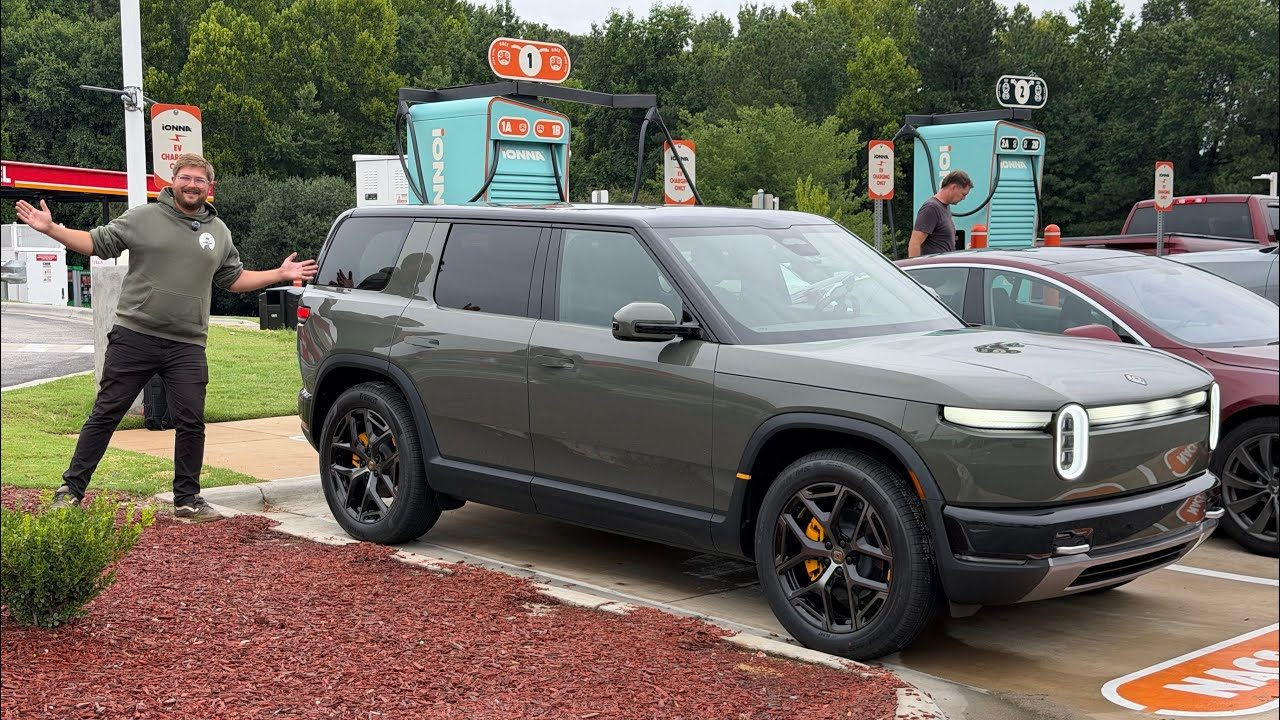
To keep up with the fastest charging vehicles, Rivian cleverly upped the allowable amperage that the R2 can accept to over 600 amps. While that can wreak havoc on an inferior charging cable adapter, it does make the Rivian R2 a charging champ, even on its seemingly older architecture. The R2 pulled a full 600 amps from the Ionna charging station until 32% SOC. So even at 400-volts, it had a blazing fast initial charge.
During the session, the R2 started pulling about 220 kilowatts pretty much immediately and peaked at 229 kW, only tapering off after around a 32% SOC. By 50%, the R2 was still pulling 165 kW, which Conner notes is far better than the sub-100-kW speed you see in a Model Y Performance at that point. After 15 minutes, the R2 managed to add 48.3 kWh at an average of 193 kW, bringing it to a 60% charge. Conner says the R2 might be the best-charging 400V vehicle on the market today.

Photo by: Rivian
After it charged up, it was time for a highway run while averaging 80 mph. That’s a bit fast for a range test, but Conner’s reasoning is that most drivers in his area average about 80 mph on the highway.
At that speed, he saw 2.2 miles per kilowatt-hour of efficiency and was able to travel 92.8 miles before the R2 depleted to a 10% SOC again. Conner calls this “just fine” and “acceptable” for road trips. In the same test, the Model Y Performance went about 10 miles farther because of its better efficiency (over 3 mi/kWh), he said, even though it charged far slower at the outset.
In the Rivian’s defense, it’d probably perform significantly better at a steady 70 mph. Rivian does its best to make its vehicles as aerodynamic as possible, but it’s still shaped like a brick, so it’s never going to as aerodynamically efficient as a sleeker, more jelly bean-shaped EV like the Model Y. For comparison, the R2 did slightly better in the test
Plus, Conner is big on using 15-minute charge ups to minimize downtime and get the car back on the road for long trips. However, if someone wanted to charge a bit longer, they could probably get to 80% without too much more wait time and that could get them more than enough juice to get to their next destination. “Most people aren’t in a rush, though, and this is going to be just fine,” he said.
So the R2 isn’t the most efficient long-distance cruiser—but it’s great at charging. The one charging caveat is that to get the R2’s full charging capability, you need to find a station capable of 600 amps. If you can, though, you’ll have no trouble charging up during road trips, as just 15 minutes can get you a ton of additional range.