Before the Stinger arrived in 2018, Kia wasn’t exactly the first name that came to mind when you thought of rear-wheel-drive performance sedans. Then the company hired former BMW M engineering boss Albert Biermann, and suddenly, Kia had a legitimate alternative to BMW, Audi, and Mercedes-Benz.
Sadly, the Stinger was never a big seller, but that’s part of what makes it so appealing today. Production ended after the 2023 model year with a limited Tribute Edition, and Kia never built a direct replacement. Just 1,000 Tribute Editions were produced globally, including 440 for the US.
Now depreciation has done what it does best. Early Stinger GTs can be found in the low-$20,000 range, while even late-model GT2s cost far less than they did new. And unlike plenty of affordable used performance cars, the Stinger pairs serious speed with four doors, a big cargo area, and enough comfort to make it a genuinely useful daily driver.
That makes the used Stinger one of the more interesting performance bargains on the market.
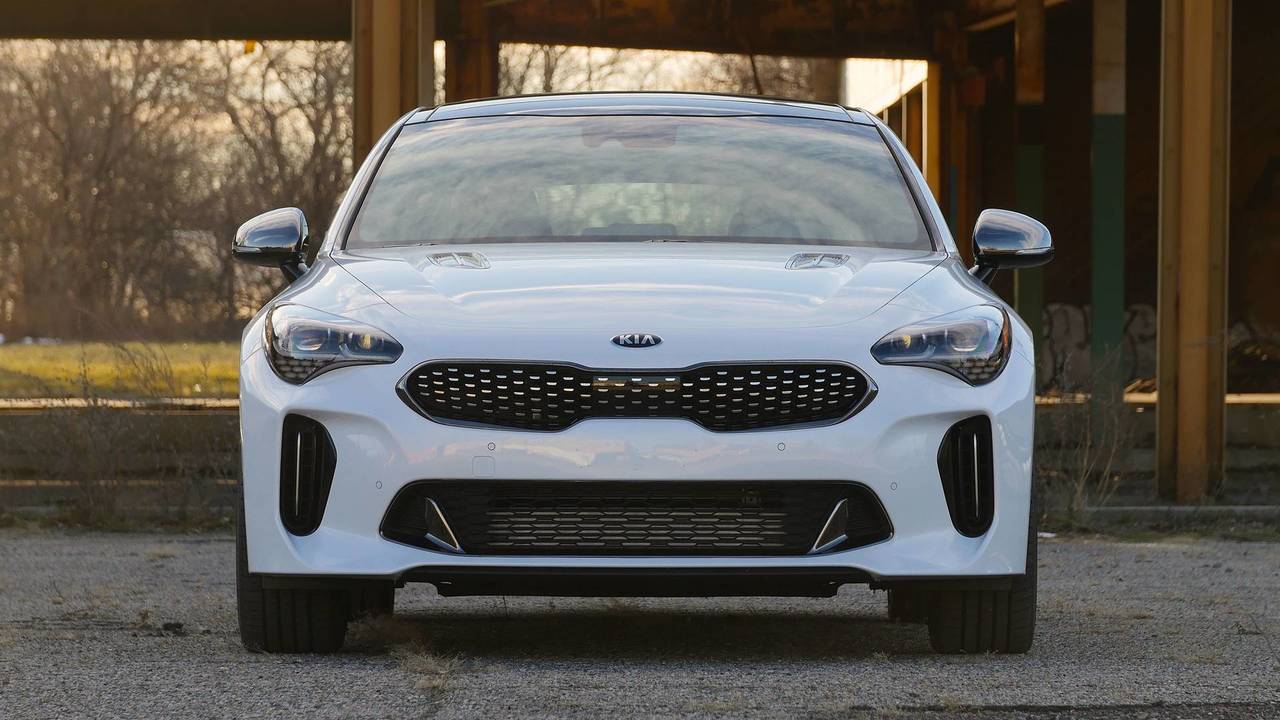
Why Buy The Kia Stinger?
Because you probably won’t believe how much car you can get for the money.
The Stinger offered several different engines over its six-year run, but the one you want is the 3.3-liter twin-turbocharged V6. When new, GT models produced 365 horsepower and 376 pound-feet of torque, routed through an eight-speed automatic transmission. Kia said that combination would hit 60 mph in just 4.7 seconds.
For 2022, Kia gave the Stinger a significant update. The V6 received a new variable exhaust system and a slight bump to 368 hp, while torque remained at 376 lb-ft. Kia also added fresh exterior lighting, revised wheels, a standard 10.3-inch touchscreen, improved interior materials, and more standard driver-assistance technology.
Rear-wheel-drive GT models get a limited-slip differential, while all-wheel-drive versions use a rear-biased torque-vectoring system. GT models also came with Brembo brakes and launch control, while upper trims added electronically controlled suspension.
And unlike something like a BMW M3, there’s a surprising amount of practicality baked into the package. The Stinger is technically a fastback, with a huge rear hatch instead of a conventional sedan trunk. The final model offered 23.3 cubic feet of cargo room behind the rear seats, which makes it genuinely useful for road trips, luggage, dogs, or whatever else you’d normally need an SUV for.
When we reviewed the Stinger for the first time back in 2018, we called it a “seriously satisfying performance bargain”:
‘It’s more than just a pretty face, though that’s a wonderful place to start.’
‘On a familiar set of canyon roads northeast of Los Angeles, the Stinger shines. The rear-wheel-drive GT dives into a corner with only the slightest hint of understeer.’
‘This car is so nicely set up right when you start the engine – Sport mode’s unique throttle mapping, transmission shift points, and steering weight don’t enhance the experience in any meaningful way.’
How Much Is A Used Kia Stinger?
You can score a whole lot of car for not a whole lot of money.
According to current Kelley Blue Book Fair Purchase Price estimates, a base model 2018 Stinger is worth about $14,000, but spend a bit more for the top-spec GT2 and you’re only at $20,600. And that’s a lot more car for the cash.
Move forward a couple of years, and prices are still pretty reasonable:
2018 Kia Stinger GT2: $20,600
2019 Kia Stinger GT2: $24,100
2020 Kia Stinger GT2: $26,400
2021 Kia Stinger GT2: $29,500
2022 Kia Stinger GT2: $32,000
2023 Kia Stinger GT2: $35,400
Those are general national estimates, of course. Mileage, condition, drivetrain, options, and location can move the numbers considerably. Still, think about what you’re getting.
A 2023 Stinger GT2 originally started at $51,890 with rear-wheel drive or $54,090 with all-wheel drive, before options. Today, comparable used examples can cost roughly $20,000 less.
Go older, and the earlier cars offer even more performance per dollar.

Which Kia Stinger Should You Buy?
I’d buy a 2022 Stinger GT2. That’s the sweet spot.
The 2022 refresh brought the newer styling, 10.3-inch infotainment system, improved driver-assistance tech, and the updated 368-hp V6 with its variable exhaust. The GT2 also offers the equipment you’d want in a long-term keeper, including electronically controlled suspension, ventilated front seats, heated rear seats, and the Harman Kardon audio system.
At roughly $32,000 today, a 2022 GT2 isn’t exactly cheap—but it’s a fantastic amount of car for the money.
If your budget is closer to $20,000, look at a clean 2018 or 2019 GT, GT1, or GT2. Mechanically, you’re still getting the 365-hp twin-turbo V6, an eight-speed automatic, available AWD, Brembo brakes, and launch control.
There’s also one particularly interesting oddball: the 2019 Stinger GTS.
Kia built just 800 of them. The GTS added bright Federation Orange paint, carbon-fiber exterior pieces, and—on AWD models—a special D-AWD system with a mechanical limited-slip rear differential and a Drift mode capable of sending up to 100 percent of the power rearward.
It’s probably the enthusiast’s Stinger to own for those in places with real seasons. Just expect to hunt for one. Otherwise, a RWD model offers the most thrills.
What Could Go Wrong?
The good news is that the Stinger doesn’t have the intimidating maintenance reputation of some similarly powerful European sedans. But there are still a few things you absolutely need to check.
The biggest current concern involves a safety recall covering roughly 35,455 Stingers equipped with the 3.3-liter twin-turbo V6, primarily from the 2018 through 2022 model years.
The left-side turbocharger oil feed pipe and hose can deteriorate from exhaust heat and potentially leak oil onto hot components, creating a fire risk. Kia’s fix replaces the assembly with an improved part. Before buying any V-6 Stinger, run the VIN through NHTSA’s recall database and verify that this work has been completed.
A much smaller recall involved certain 2020 and 2021 Stingers. A manufacturing defect in the fuel pump’s jet nozzle housing could restrict fuel flow and potentially cause the engine to lose power. Only 635 vehicles were affected, but it’s another reason to check the VIN before handing over any money.
Then there are the normal used-performance-car concerns. Look closely at the tires and Brembo brakes. Check that the car tracks straight and doesn’t vibrate during braking. Inspect for mismatched tires or cheap replacements, which can be a clue that a previous owner wasn’t particularly interested in spending money on proper maintenance.
Modification history matters, too. The Stinger’s twin-turbo V6 responds well to tuning, so there are plenty of modified examples floating around with intakes, exhausts, ECU tunes, and other upgrades. None of that automatically makes a car bad, but a stock example with documented maintenance is generally the safer bet.
What Are The Alternatives?
There are a few obvious alternatives to the Kia Stinger:
BMW M340i
Genesis G70 3.3T
Mercedes-AMG C43
The G70 might be the most obvious. It shares much of its underlying hardware with the Stinger and was available with the same basic twin-turbo 3.3-liter V6. The Genesis has a nicer interior and a more premium badge, but it sacrifices the Stinger’s enormous hatchback cargo area.
Then there are the Germans.
A used BMW 340i or M340i serves up performance via its excellent inline-six and arguably sharper driving dynamics. The Audi S4 offers standard all-wheel drive and a delightful interior. A Mercedes-AMG C43 gives you similar compact luxury-sedan performance with considerably more badge prestige.
Why The Kia Stinger Makes Sense
The Stinger was always a strange proposition as a new car.
Kia was asking buyers to spend $50,000 or more on a badge they weren’t necessarily accustomed to seeing next to BMW and Audi. The car itself was good enough to compete, but convincing traditional luxury-car buyers was another matter.
As a used car, you’re no longer comparing a $52,000 Kia against a brand-new BMW. You’re looking at a 365- or 368-hp rear-wheel-drive sport sedan with Brembo brakes, an available limited-slip differential, a massive hatchback cargo area, and a twin-turbo V6 for somewhere between $20,000 and $35,000.
And that is a much easier argument to make.
Why Buy A Used Jaguar F-Type? Because It Still Feels Special
Why Buy A Used Lexus GS F? Because A High-Revving V8 Sedan Is Worth Saving
Why Buy A Used Ford Focus RS? Because It’s Still Special
Why Buy A Used Chevy SS? Two Words: V8. Manual.