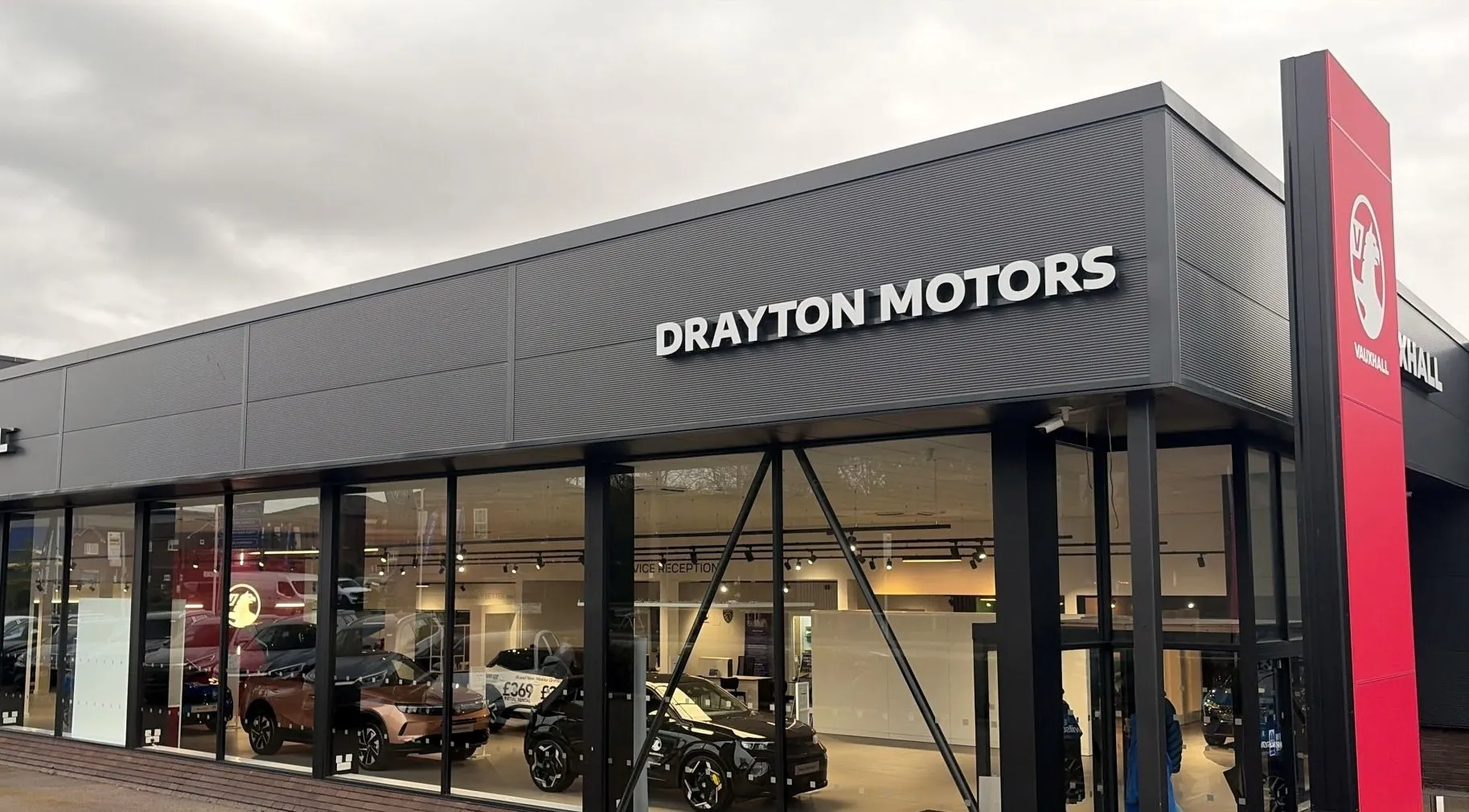
What’s in a name? Last month group managing director of RJTK Group Chris Roberts decided that the company had too many. For years it had traded as Drayton Motors and Wilson and Co Motor Sales. He decided to drop the latter and keep it focused. The rationale was that marketing two brands was inefficient.
Roberts said it was a new era in the evolution of the business it adopt the group-wide automotive trading name of Drayton Motors.
“Our Wilson and Co Motor Sales history will always be part of our DNA, but ultimately trying to market and run two brand names is both costly and ineffective,” he said.
The move had been two years coming. Roberts joined the business in January 2024, initially working in a non-executive capacity and subsequently taking on the group MD role. He has a lengthy career in automotive. Most recently he has worked as a consultant with businesses on strategic planning, governance and leadership. He served with Cambria Automotive in operations and business development and he was group MD of Drive Motor retail. On the OEM side he served as UK and European dealer network development with Vauxhall and Opel.
For Roberts, when he joined the group in 2024, the need for change was apparent.
“The business had a lot of process issues around different ways of operating between the two sides of the business. I started streamlining processes and some of the controls,” he said.
The company was “very much a group of dealerships” rather than a dealership group, he added.
“We were marketing Wilson and Co on one side and Drayton Motors on the other side. And we were also trying to market RJTK, which is the holding company. It was a bit of a mess.
“In the last two years, I’ve done a lot of work on the processes and controls, restructured the management teams and realigned the operations team,” he said.
Roberts worked as director of network development for Vauxhall and Open in the UK and Europe between 2013 and 2017. So, in almost a decade what are the biggest changes he has seen in dealerships since then?
“I think one of the big things that we’ve lost, and it’s a bit of a COVID thing really, is we lost management controls. A lot of people were new managers and so they hadn’t really got the in-depth management skills that were needed in the business.”
Perhaps precisely because he has worked both sides of the fence in dealer development and as a dealer boss, Roberts has clear views on OEMs and their relationship with franchised dealers.
“In my view, what manufacturers should do is build great quality cars and then appoint the right dealers to get on with selling them instead of interfering in every element of the business to try and control what the dealer does. It’s just not a great recipe for success in my view.
“You know, they rarely look at the profitability of some of the actions they take. Whilst they do look at overall dealer profitability, some of the programmes that sit within the model are not always very sensible or commercial for the dealer.
“It needs a balanced view. A good friend of mine would say what they need in some OEMs is a few grey hairs around who’ve seen it and done it before, who understand when you pull that lever what happens down the line,” he added.
Roberts has also looked at the culture of the company and the values it represents.
“The other key thing we’ve done is we’ve realigned our core values as a group. These have got very fragmented. Our core values have now been realigned into three channels. Driving excellence for our customers, our colleagues and our stakeholders. And if we do all three correctly, then we will achieve excellence. That must be lived and breathed by the senior management, not just put on a wall board and a poster,” he said.
“We’re trying to evidence actions and activities based off core values. And we’re going to introduce an awards programme for people who demonstrate exceptional activities around the core values.”
Roberts gives an example of the community actions the company takes.
“We just we just run a big benefits match, a charity match. One of our colleagues was sadly killed in a car crash last year. We ran a massive charity event for him, raising over £10,000 pounds. One of our heads of business was instrumental in making that happen,” he said.
Robert also overhauled the training programme at the dealership.
“I canned all the ad-hoc training that was happening in 2024 to build a framework. We’ve now brought in a group training manager and we’re creating an academy framework. Every job role in the business will have a personal development plan attached to it. And then with a credit to a bronze, silver, gold accreditation for every team member in the business.
“What the industry’s never been very good at is demonstrating you can have a career [in motor retailing]. It’s always been you come in to do one job and unless your boss dies or leaves, you’re just stuck in that job. Over the years, I’ve always tried to build high performing teams. And part of that foundation is to get the training in the academy structure right.
“We’ve got a good female mix of the workforce. We’ve got a good apprentice base. We’ve got a good ethnic mix in the workforce. You know, and that stands us in good stead because we are a very balanced business in that respect. You know, we have a lot of controls internally around care in the workplace. We do a mental health programme. We subscribe to Ben, who provides support to us when we need it around things like mental health,” said Roberts.
Group franchises
The group consists of ten dealerships covering Greater Manchester, Lancashire & Lincolnshire. The group is ranked 103 in the Motor Trader Top 200 Dealer Groups with annual turnover of £155.4m. It has a mix of franchises including Vauxhall, Peugeot and Suzuki and more recently Chinese brands BYD and the Chery owned Omoda and Jaecoo brands.
What is it like working with these new entrants and what makes them different?
“They come with no baggage in the UK, which is helpful in terms of infrastructure and systems. They are still building that. So, the legacy brands tend to have a better handle on logistics, vehicle deliveries and aftersales support.
 “Our experience of those three brands is very good now. The cars have been available in the main, the odd logistics hiccup. They’ve got pull as opposed to a push from a consumer perspective. So that’s helpful. The pricing strategy is very good.
“But, you know, we still perform with our legacy brands. I mean, Kia is very strong. Vauxhall, we’re making that work despite the difficulties. And we have Suzuki, which is performing better than the prior year,” he said.
“One of the strategic things I’ve done, I’ve tried to rationalise the rooftops. We had a couple of rooftops that were not really optimal. We’ve relocated our Boston Kia site into a brand-new purpose-built facility. And we’re looking to restructure a couple of other sites to do the same thing,” he said.
“Streamlining the brands we must we’re growing with brands that work has been important, so I took out KGM and Maxus. The Maxus business had been based in Lincolnshire, and the location was not ideal for the brand.
“The brand is probably okay, but our location didn’t help. And I don’t think at the time the team got fully behind it. It didn’t really work and we had to cut our losses. It’s made us slightly hesitant in terms of taking on any other full EV commercial product,” said Roberts.
Motor finance
Two big issues impacting dealers in 2026 are the motor finance redress scheme (whatever the form it takes) and the ZEV Mandate.
Roberts said dealer sales staff are not getting much input from customers on the redress process.
“Customers appear more than happy. Our finance revenues have not gone down. We follow the rules all the way through, as have most dealer groups, you know. If people don’t get the finance, they probably can’t afford the car is the truth. You look at what PCP rates have been like with people buying high-end cars, Mercedes, Audi, BMW, very cheap payments. They couldn’t probably have afforded that car without finance.”
On the ZEV Mandate he is direct and believes the government strategy is conflicted with rising ZEV annual targets offset by the introduction of £200 VED for electric cars.
“I think anybody with any knowledge of the industry knows it’s all counterproductive, because on one hand, the Government is setting a ZEV target and then taking away support monies. It all doesn’t join up in my view. They’re almost fighting themselves.”
Given that Roberts has sorted the rooftops and put in place the training and the new structure, what plans has he got for the future? From the outset he had a five-year plan.
“Number one was getting the team set with the right people in the right chairs and the skill sets we needed and to build the platform for training and skills within the business, which we’ve also now kicked off this year, stabilize the processes and make sure the business is sustainable and investable. We’ve got a strong balance sheet and a lot of freehold property. And then the step beyond that is to then look for acquisitions, which is about where we are today.”
The plan is to grow with existing brands to give greater scale and efficiencies.
“I think we’re happy with what we’ve got now. I think the churn we’ve had has happened. We grow with the current partners for sure. Even though Vauxhall is a challenge, we know it well. My ops directors worked with me before heavily in Vauxhall, so we understand the brand.
Roberts is also looking at new brands but points out that taking on one dealership for a particular brand is not the best option. Having three or more dealerships with a given brand is preferable, giving greater influence when it comes to OEM relationships.
“If you ring the manufacturer, they’ll at least answer the phone. You know, if you’ve got one dealership, it doesn’t really work.”
Roberts like all dealers must deal with shortage of vehicles in the used car sector caused by declining new car sales in successive years during COVID.
“One thing is we hadn’t been very good at new retail. So for me, new retail is anybody who walks in the door, whatever they say they want to buy, we should offer them a new retail car because a number of times people don’t know they can afford a new retail car and come in and ask for a used one because they think that’s where they are in terms of payment. And by selling newer, and we have absolutely done that this year, we’re generating better used cars and they are the best source of used car stock.”
Roberts highlights the cost of sourcing used stock from auction and believes there must be a better way.
“Look at the numbers now. it’s quite scary. You used to pay 100 pound a car at the auction and now you’re paying £300, £400, plus delivery plus this, plus that. You’re £1,000 in before you’ve even got the car on the forecourt. The criticality of generating your own stock is important,” he said.
“We don’t generally participate in the approved use schemes because we sell all our own warranties and everything internally. We do our all-self-administered products. I try and steer clear of the manufacturer ones.”
I ask Roberts to sum up where the group has come from and there it will end up.
“The strategic bill, the five-year plan, the processes, the name-change, the brands, the rooftops, the academy, the core values, they’re all the main elements of the business and probably gives you that bit of the jigsaw of the name change. It sort of all makes sense,” he said.