


An automaker’s design team wants its products to be identifiable, ideally even before you notice the badge. Aside from the iconic roundel, BMWs are chock-full of design elements that set them apart from the competition.
There’s the unmistakable dual kidney grille and double headlights up front, while the rear typically features a subtle L-shaped motif embedded in the taillights. What about the profile? Enter the Hofmeister kink (knick in German).
Welcome to Motor101, our series dedicated to answering the internet’s biggest automotive questions. From the origins of iconic designs to the engineering breakthroughs that shaped the world’s greatest cars, we uncover the fascinating stories behind the vehicles you love.
What Is The Hofmeister Kink?
Photo by: BMW
While it traces its roots to design sketches from the 1950s, the Hofmeister Kink didn’t appear on a production model until the 3200 CS (pictured above) and 1500 launched in 1961. However, it’s important to note that BMW didn’t invent what later became an immediately recognizable design trait.
Some American cars, such as the Kaiser Deluxe, featured the edgy rear-pillar design accent in the late 1940s and early 1950s. Italians also beat BMW to the punch with the Lancia Flaminia.
That said, it’s BMW’s consistency that turned it into a defining design element after its introduction on Bavarian models some 65 years ago. As you can imagine, the Hofmeister kink received its name from the man who first applied it to a BMW: Wilhelm Hofmeister. The longtime Director of Body Engineering and Development came up with the idea of the tight curve in the rearmost side window.
The Hofmeister Kink’s Staying Power

Photo by: BMW
BMW Group Design Identity’s David Carp explained in an article for the BMW M magazine that the kink wasn’t born out of necessity, but it does deliver tangible advantages.
‘One functional benefit is that the kink allows for a larger side window area in the door without having to incorporate an additional window before the C-pillar. From a design perspective, the curve creates greater tension in the lines and surfaces, resulting in a more dynamic side view. It makes a vehicle’s appearance more robust without adding bulkiness.’
In an interview with MotorTrend back in 2015, former BMW design chief Chris Bangle detailed the two advantages of having a Hofmeister kink:
‘One, it permits a reasonable-sized fixed glass triangle to give the rear door window a stabilizing ‘straight’ drop guide, permitting it to be as far back as possible and still get the glass down all the way.
Secondly, it extends the daylight opening of the upper with its extra piece of glass and pushes the door’s opening line far back over the wheelhouse, allowing a better entry/exit. If it is too ‘pinched’ and extended, it actually makes opening the door harder. But beginning the curve of the opening around such a ‘knick’ is a good way to get a useful opening.’
Some say the design element kinks forward to evoke the rear-wheel-drive character of all BMWs. Well, “all” until front-wheel-drive models arrived in 2014 with the 2 Series Active Tourer minivan. Whatever the case may be, BMW admits that, back in the day, legendary Italian designers such as Giovanni Michelotti and Giorgetto Giugiaro directly influenced the Hofmeister kink.
Hofmeister’s History
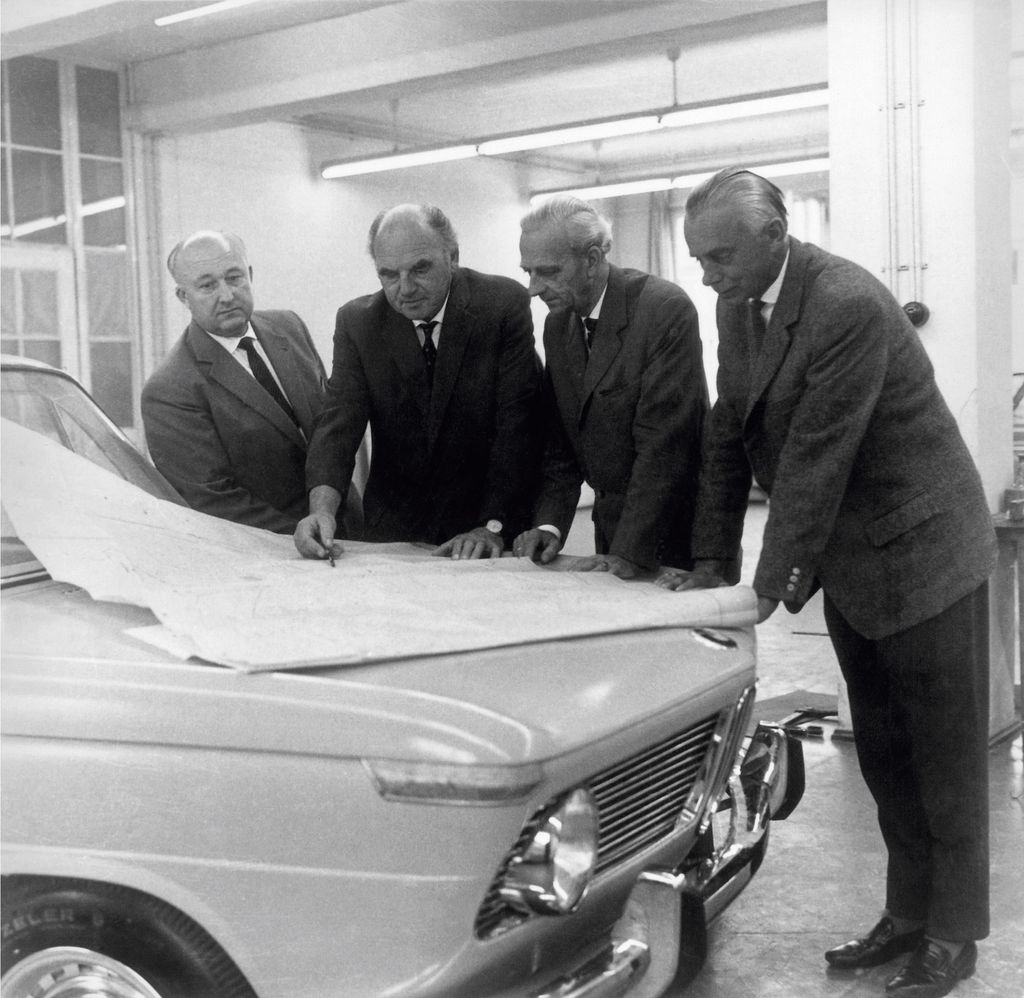
(left to right) Hofmeister, Fiedler, Wolff, von Falkenhausen with a BMW 1500 in 1970.
Photo by: BMW
Originally a mechanical engineer, Hofmeister headed BMW’s design department from 1955 until 1970, when the legendary Paul Bracq replaced him. Much like the kidney grille, the kink has evolved over the decades and remains a signature design trait today.
However, it hasn’t been used universally, as some models skipped it altogether, including the Z3 M Coupe, the quirky i3 hatchback, and wagons such as the original 5 Series Touring.
Of course, BMW doesn’t own a design patent for the kink, since other automakers have used it over the years. Nevertheless, there’s a good chance it’s the first brand that comes to mind the next time you see it. That sense of familiarity has forged a connection spanning decades, and it’s still going strong today.


