One of the biggest differences in driving an electric vehicle is what is not happening underneath you.
There are no gear changes. No rising engine note before an upshift. No automatic transmission shuffling between ratios. In most EVs, the accelerator simply delivers a smooth, uninterrupted surge of power from a standstill all the way to highway speeds.
That’s because most battery-electric vehicles use a single-speed reduction gear instead of the multi-speed transmissions found in gasoline- and diesel-powered cars. So why can an EV get away with just one gear when a gas car might have eight, nine, or even 10?
The answer comes down to the fundamental difference between an electric motor and an internal-combustion engine.
Electric Motors Don’t Need A Bunch Of Gears
A gasoline engine operates within a relatively limited range of speeds where it can produce useful power and torque. That’s why a conventional transmission has multiple gears: It keeps the engine operating in a useful range while the vehicle goes from a crawl to highway speeds.
An electric motor has a much broader useful operating range. That makes it possible to connect the motor to a fixed reduction gear and let the motor handle a much wider range of vehicle speeds.
Another advantage is torque delivery. Electric motors can produce substantial torque from very low rotational speeds, which is exactly what a car needs when pulling away from a stop.
There’s no need to wait for an engine to build revs before the vehicle starts accelerating. An EV can use a fixed gear reduction to multiply the motor’s torque and send it directly to the wheels.
Why Gas Cars Need More Gears
A gasoline engine has a much narrower operating window, so adding more gears allows engineers to keep the engine closer to its most useful operating range.
That’s why modern gasoline vehicles can have transmissions with eight, nine, or even 10 forward gears. Each ratio helps the engine operate efficiently as vehicle speed changes.
An EV doesn’t face the same problem to nearly the same extent. Instead of repeatedly changing ratios to keep the engine happy, the electric motor can simply increase or decrease its rotational speed as the vehicle accelerates or slows.
The result is a drivetrain that can deliver smooth acceleration without the noticeable shifts associated with a conventional transmission.
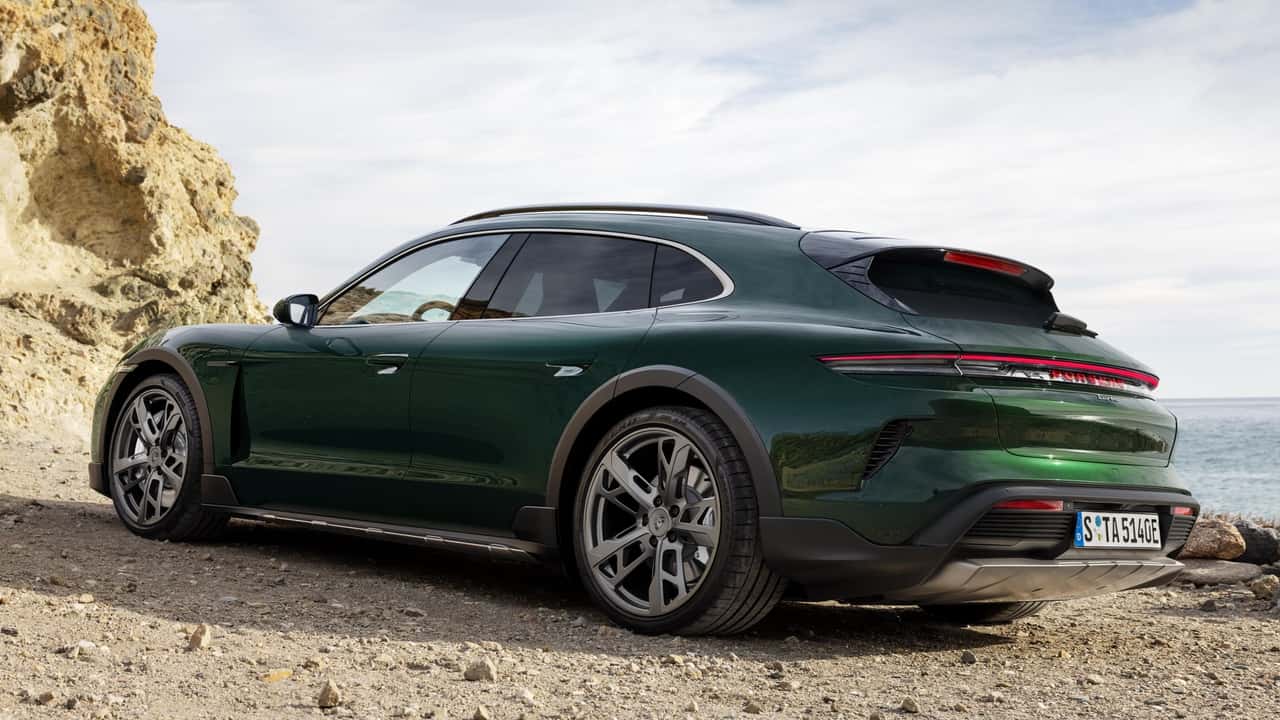
Porsche Taycan Cross Turismo
Photo by: Porsche
What Does The ‘One Gear’ Actually Do?
It’s important to understand that an EV’s single-speed setup isn’t simply a direct connection between the motor and wheels.
The motor typically spins much faster than the wheels, so the drivetrain uses a fixed reduction gear to reduce motor speed while multiplying torque before it reaches the wheels. The basic arrangement is the following:
Electric motor: Produces rotational power.
Reduction gear: Lowers the motor’s high rotational speed.
Differential: Allows the driven wheels to rotate at different speeds while cornering.
Wheels: Convert mechanical power into forward motion.
Because there aren’t multiple gear ratios to change between, the drivetrain can also be mechanically simpler than a conventional multi-speed transmission.
One Gear Doesn’t Mean Every EV Has One
There is an important exception to the “EVs have one gear” rule. Not every electric vehicle uses a single-speed transmission. Some high-performance and efficiency-focused EVs use two-speed gearboxes.
The Porsche Taycan and its sister car, the Audi e-tron GT, are two well-known examples. Their rear axle uses a two-speed transmission, with first gear helping acceleration and second gear designed for higher-speed efficiency and performance. Another EV that has a two-speed transmission is the latest Mercedes-Benz CLA based on the MMA platform.
Multi-speed transmissions can make sense when automakers want to optimize different aspects of an EV’s performance. A lower ratio can help with acceleration or steep grades, while a taller ratio can reduce motor speed at higher road speeds.
However, additional gears also bring extra weight, complexity, moving parts, and potential mechanical losses. If a single-speed setup already provides the desired acceleration, top speed, efficiency, and durability, there’s little reason to add that complexity.
Could EVs Benefit From More Gears?
Sometimes, yes. A multi-speed gearbox can allow engineers to use different ratios for different driving conditions. This can be particularly useful for vehicles where high-speed performance, towing, heavy loads, or maximum efficiency are major priorities.
But for an ordinary EV, the benefits may not justify the added complexity. Electric motors already have a wide operating range and strong low-speed torque.
That means a single fixed ratio can provide everything from quick launches to highway cruising without requiring the drivetrain to constantly change gears.
This is also one reason EVs can feel so different from gasoline-powered vehicles. Instead of managing several transmission ratios, the vehicle’s electronics can precisely control motor output almost instantaneously.

Hyundai Ioniq 5 XRT
Photo by: Hyundai
What Fans Think About EVs And Gears
Reddit discussions show that the question of EV transmissions is more complicated than it might initially seem. In one r/electricvehicles discussion, a user asked whether any electric cars actually use multiple gears. The conversation eventually pointed to the Porsche Taycan and Audi e-tron GT as notable exceptions.
Another Reddit thread asked why an EV couldn’t use a gearbox to improve highway efficiency. The discussion largely came down to the same tradeoff engineers face: a second or third gear can provide benefits in certain situations, but it also adds weight, cost, complexity, and mechanical losses.
A separate discussion about two-speed EV transmissions dug deeper into the subject. Commenters debated whether multiple ratios could make EVs more efficient, with several pointing out that electric motors already operate efficiently across a relatively wide range of RPM.
The overall Reddit consensus is pretty close to the engineering logic: multiple gears can be useful, but they’re simply not necessary for most EVs. The Porsche Taycan is a good example of when an extra ratio can make sense, while the vast majority of electric cars can achieve their performance and efficiency targets with a single-speed reduction gear.
The Simple Answer
So, why do EVs usually have only one gear? Because electric motors don’t need the same range of gearing that gasoline engines do.
An electric motor can operate effectively across a broad range of speeds and deliver strong torque from very low speeds. That allows automakers to use a fixed reduction gear instead of a conventional multi-speed transmission.
There are exceptions, and some EVs benefit from having two or more ratios. But for most electric cars, one gear is enough—and that simplicity is actually one of the advantages of electric propulsion.
What looks like a missing piece of an EV drivetrain is really a sign of how fundamentally different it is from a gasoline car. The motor doesn’t need to shift gears because it was never playing by the same rules as an internal-combustion engine in the first place.
What Happened To Scion?
Was The DeLorean Actually A Terrible Sports Car? Yes And No
Why Some Cars Have Different Colored Brake Calipers
Why Do Cars Have Model Years?