You’re cruising down the highway when your truck hits a pothole, expansion joint, or seemingly harmless bump. Suddenly, the steering wheel starts shaking violently from side to side. The front end feels like it’s trying to tear itself apart, and the vibration might not stop until you dramatically reduce your speed.
Congratulations: You may have just experienced the infamous death wobble.
Despite the dramatic name, death wobble isn’t a specific broken component. It’s a violent oscillation of the front suspension and steering system most commonly associated with vehicles using a solid front axle—including Ford Super Duty and Ram Heavy Duty pickups, as well as vehicles like the Jeep Wrangler.
And unfortunately, finding the cause isn’t always as simple as replacing one part.
What Actually Causes Death Wobble?
Death wobble usually begins when something allows excessive movement in the steering or suspension. Then a bump in the road provides the trigger.
Instead of the suspension absorbing that initial movement and settling down, looseness in the system allows the front wheels and axle to oscillate rapidly from side to side. The steering linkage transfers that movement directly into the steering wheel.
Common culprits include:
- Worn track-bar bushings or joints
- Loose track-bar mounting hardware
- Worn tie-rod or drag-link ends
- Worn ball joints
- Worn wheel bearings
- Improper wheel alignment
- Incorrect caster
- Unbalanced or damaged tires
- Loose suspension hardware
Often, it isn’t one spectacularly failed part. Several components may have accumulated a small amount of play, and together they create enough movement for death wobble to develop.
That’s also why diagnosing it can become frustrating.
A recent discussion on Reddit by an F-350 owner is a good example. Other truck owners suggested everything from damaged tires and alignment to track-bar joints, ball joints, shocks, and steering components based on their own experiences.
Why Does It Happen So Often on Heavy-Duty Trucks?
The common denominator is usually the solid front axle.
Unlike an independent front suspension, where each front wheel can move largely independently, a solid axle mechanically connects both wheels. A track bar locates the axle beneath the vehicle, while the steering linkage controls the wheels.
That’s a strong, relatively simple setup—which is exactly why manufacturers continue using solid axles on many heavy-duty trucks and serious off-roaders.
But when bushings, joints, or mounting points develop play, movement on one side can affect the entire axle. Add highway speed and a sharp bump, and the resulting forces can sometimes create the oscillation drivers call death wobble.
Large aftermarket wheels and tires can make matters worse, too. They add load to steering and suspension components and can accelerate wear. Lift kits can also alter caster and other suspension geometry if they aren’t properly installed and aligned.
Is It Just A Bad Steering Stabilizer?
This is where things get complicated.
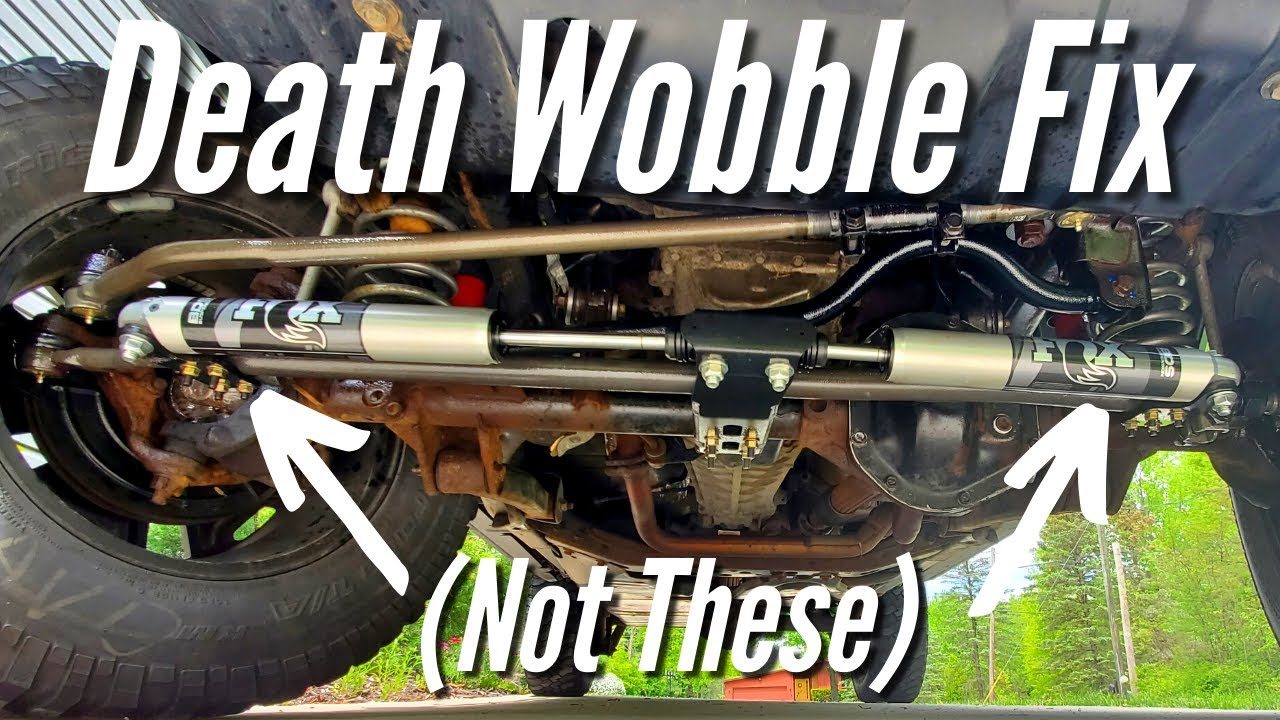
The steering stabilizer, essentially a small shock absorber attached to the steering system, is often one of the first parts replaced when death wobble appears.
And replacing a worn stabilizer might reduce the symptoms.
But installing a stronger steering stabilizer doesn’t necessarily address whatever allowed the oscillation to develop in the first place. If your track bar has excessive movement or your ball joints are worn, for example, a big aftermarket stabilizer may simply make that looseness harder to notice.
The better approach is to inspect the entire steering and front suspension system, repair anything worn or loose, check the wheels and tires, and then verify the alignment.
How Do You Know It’s Really Death Wobble?
A vibration doesn’t automatically mean your truck has death wobble.
An out-of-balance tire, for instance, can create a steering-wheel vibration that appears around a particular speed and then fades as you accelerate or slow down.
Death wobble is far more violent.
Typically, the truck will be driving normally until something—often a bump—triggers the front end. The steering wheel then begins to oscillate rapidly, sometimes shaking the entire cab, and the vibration continues until the vehicle’s speed is significantly reduced.
If you’re wondering whether what you experienced was death wobble, there’s a good rule of thumb: If you’re not sure, it probably wasn’t.
Actual death wobble is often unforgettable.
What Should You Do If Death Wobble Happens?
The most important thing is to reduce speed in a controlled manner.
Keep your steering inputs smooth, ease off the accelerator, and gradually slow the truck until the oscillation disappears. Avoid suddenly slamming on the brakes or making aggressive steering inputs while the front end is shaking. Once it’s safe, pull over.
More importantly, don’t treat the fact that the shaking stopped as proof that the problem went away.
Have the front suspension and steering system inspected before returning to normal highway driving. Death wobble can place tremendous loads on components that may already be worn.
Can Death Wobble Be Fixed?
Absolutely.
But there’s rarely a universal “death wobble fix.”
A technician needs to identify the source of the movement causing the oscillation. That usually means inspecting the track bar and its mounting points, tie rods, drag link, ball joints, bushings, wheel bearings, wheels, tires, and alignment.
Once the worn components are repaired and the suspension geometry is correct, the wobble should disappear.
So if your truck suddenly starts trying to shake the steering wheel out of your hands, don’t just bolt on the biggest steering stabilizer you can find.
Your truck is probably telling you that the front end needs attention.