One of the first things many drivers notice after getting behind the wheel of an electric vehicle is that lifting off the accelerator doesn’t feel quite like it does in a gas-powered car. Instead of slowing down gently, the vehicle feels like it actually brakes—sometimes enough to bring itself to a complete stop.
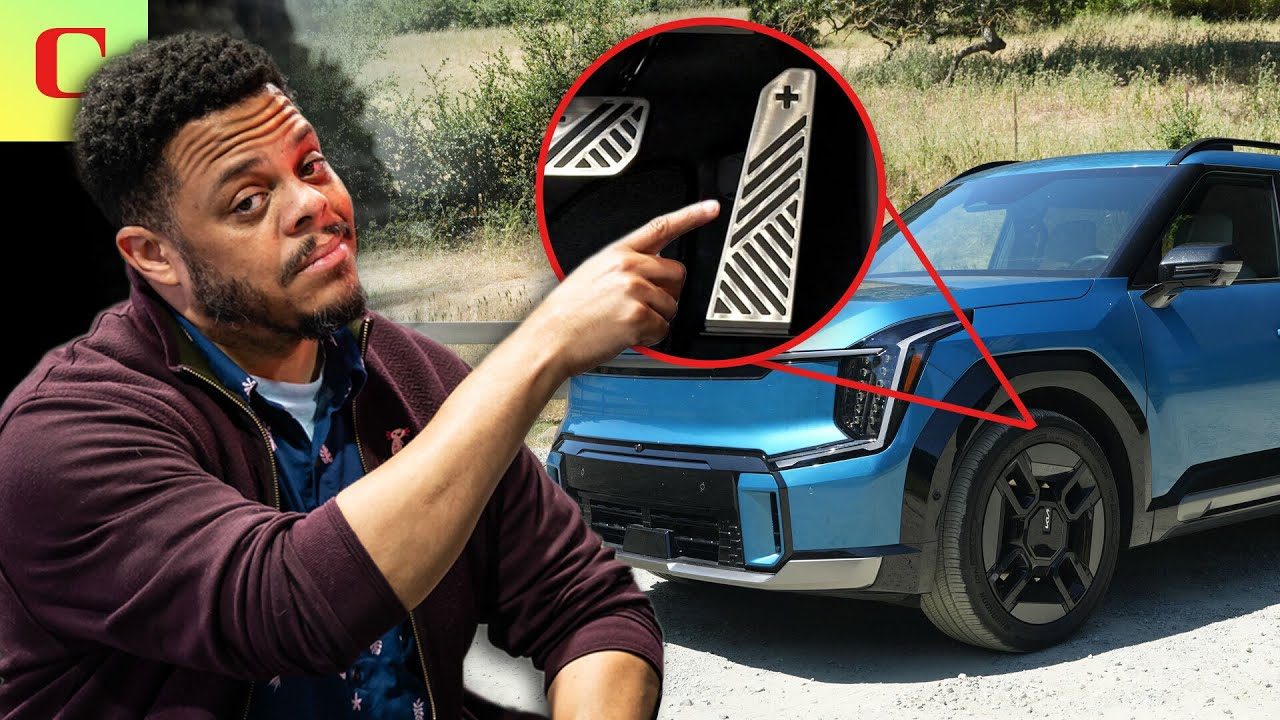
That’s one-pedal driving, and despite the name, it doesn’t mean EVs literally have only one pedal; the brake pedal is still there. Instead, the system allows drivers to handle much of their everyday acceleration and deceleration with just the accelerator pedal.
Welcome to Motor101, our series dedicated to answering the internet’s biggest automotive questions. From the origins of iconic designs to the engineering breakthroughs that shaped the world’s greatest cars, we uncover the stories behind the vehicles you love.
How Does One-Pedal Driving Work?
It can feel strange at first, but there’s a very practical reason automakers offer it: an EV can turn some of the energy normally lost during braking back into electricity. The key technology behind one-pedal driving is regenerative braking.
When you lift off the accelerator in an EV, the electric motor can switch from using electricity to propel the vehicle to operating as a generator. The motion of the car turns the motor, creating electrical energy that can be sent back into the battery.
At the same time, the system creates resistance that slows the vehicle. That’s why lifting off the accelerator can feel similar to pressing the brake pedal in a conventional car. The amount of deceleration varies between vehicles and driving modes. Some EVs let drivers adjust the strength of regenerative braking, while others provide a more consistent one-pedal experience.
The important distinction is that one-pedal driving doesn’t eliminate braking hardware. The conventional friction brakes are still there and remain essential when stronger or emergency braking is required.
Why Do EVs Use One-Pedal Driving?
The biggest reason is efficiency. A conventional gasoline car generally turns much of its kinetic energy into heat when the brakes are applied. The brake pads clamp onto the rotors, slowing the vehicle while that energy is essentially lost. An EV can recover some of that energy instead.
When regenerative braking slows the car, the electric motor acts as a generator and sends some electricity back toward the battery. It isn’t a perfect process—energy is lost along the way—but recovering some energy is better than turning all of it into heat.
One-pedal driving also makes use of something EVs are particularly good at: precise control of electric-motor torque.
An electric motor can respond almost instantly to changes in accelerator input, allowing engineers to create a smooth transition between accelerating, coasting and regenerative deceleration.
Is One-Pedal Driving More Efficient?
It can be, but it shouldn’t be viewed as a magic range-extending feature. Energy regeneration is most useful when the vehicle needs to slow down. Instead of wasting all that kinetic energy through the friction brakes, the vehicle can recover a portion of it.
But regenerative braking can’t recover energy that the car doesn’t need to lose in the first place. For example, if you’re traveling steadily on a highway, maintaining a consistent speed is generally more efficient than repeatedly accelerating and then using regenerative braking to slow down.
That’s why good EV driving isn’t about constantly lifting off the accelerator. It’s about anticipating traffic and road conditions so the vehicle slows smoothly and efficiently.
Why Does It Feel So Different?
The sensation can take some getting used to. In a gasoline-powered car, lifting off the throttle generally causes the vehicle to slow down due to engine braking or coast (on vehicles fitted with a coasting function). In an EV with strong regenerative braking, lifting off can produce much more noticeable slowing.
For an experienced EV driver, that can make stop-and-go traffic surprisingly easy.
Instead of repeatedly moving between the accelerator and brake pedals, the driver can modulate the accelerator to control the vehicle’s speed. Ease off slightly and the car slows gently. Lift off more completely and the car may slow much more aggressively.
The result can feel almost like the accelerator pedal is also a brake control. That’s where the term one-pedal driving comes from.
Are There Any Downsides?
One-pedal driving isn’t necessarily ideal in every situation. The most obvious issue is that it changes the way drivers expect a car to behave. Someone accustomed to conventional vehicles may initially find the strong deceleration surprising, particularly when lifting off the accelerator at higher speeds.
There are also situations where regenerative braking can be reduced or unavailable. Battery temperature, state of charge and other vehicle conditions can affect how much regenerative braking the system can provide.
The main things drivers should know are:
- It takes some practice. Strong regenerative braking can feel unusual until the driver learns how much to lift off the accelerator.
- The brake pedal still matters. One-pedal driving doesn’t replace conventional braking for harder or emergency stops.
- Regeneration isn’t always available at full strength. Battery conditions and other factors can limit how much energy the vehicle can recover.
- Not every driver likes it. Some people prefer strong regenerative braking, while others find lighter regeneration more natural.
- Driving conditions matter. One-pedal driving can be especially convenient in stop-and-go traffic, but different situations may call for different levels of regeneration.
Some automakers also allow drivers to choose between different levels of regenerative braking, giving them the option to make the vehicle feel more like a conventional car.
EV Drivers Can’t Agree On One-Pedal Driving
EV owners on Reddit have plenty to say about one-pedal driving, and the debate isn’t quite as simple as whether people like it or hate it.
In a recent r/electricvehicles discussion, one owner questioned whether one-pedal driving actually improves efficiency, arguing that coasting can be more efficient than repeatedly converting the vehicle’s kinetic energy into electricity and then back into motion. Other commenters agreed that coasting can have an efficiency advantage, while pointing out that one-pedal driving is often easier and more natural in real-world traffic.
That distinction comes up repeatedly: one-pedal driving isn’t necessarily the most efficient technique in every situation. If a driver can anticipate traffic and simply coast rather than accelerate and then regenerate, there may be less energy lost in the conversion process. But convenience is a major part of the appeal.
In another r/electricvehicles thread, an owner said that after driving with one-pedal mode for several weeks, the behavior became automatic. The driver even found conventional gasoline-car behavior strange afterward because the car continued moving when the accelerator was released.
Other owners are less enthusiastic. Some prefer conventional two-pedal driving because it makes coasting easier and gives them a different way to manage speed. That split suggests there isn’t one universally “correct” way to drive an EV.
For many drivers, one-pedal driving is ultimately about control and convenience rather than maximizing range at every possible moment. In stop-and-go traffic, it can make driving feel remarkably simple. On an open road, deliberately coasting may make more sense.
The Reddit debate essentially backs up the bigger point: one-pedal driving is a tool, not a requirement. The best approach depends on the vehicle, the road and how the driver prefers to manage speed.
So, Why Do EVs Have It?
The answer is a combination of efficiency, control and convenience. Electric motors can both propel a vehicle and recover energy when the vehicle slows down. One-pedal driving puts that capability directly under the driver’s right foot, making regenerative braking a natural part of everyday driving.
It can also make urban driving less tedious because the driver doesn’t have to move between two pedals as frequently in stop-and-go traffic.
But the technology isn’t mandatory, and it isn’t necessarily the best choice for every driver. Some people love the ability to control an EV almost entirely with the accelerator. Others prefer lighter regenerative braking and more familiar two-pedal driving.
Either way, one-pedal driving is both a quirky EV feature and a clever way of taking something cars have always done—slow down—and using it to put some energy back into the battery instead of simply turning it into heat.