Getting a flat tire doesn’t necessarily mean you’re about to buy four new tires. In some situations, replacing just one tire is perfectly possible, although it depends on how much tread remains on the other tires, the type of vehicle you drive, and what the manufacturer recommends.
The problem is that a brand-new tire can have significantly more tread than the three tires already on your car. That difference changes the tire’s rolling circumference, which can affect handling and, on some vehicles, the operation of electronic and mechanical systems.
When You Can Replace Just One Tire
If the other three tires are relatively new and have very similar tread depth, replacing a single damaged tire can be a reasonable option.
The replacement should match the existing tires as closely as possible in size, type, brand, model, load rating, and speed rating. Michelin specifically says that if only one tire needs replacing, it should match the other three as closely as possible, including remaining tread depth.
The US Tire Manufacturers Association also says a single replacement can be appropriate in some circumstances, but recommends pairing it with the tire having the deepest remaining tread and putting the pair on the rear axle (if your car is front-wheel drive).
All-wheel drive is particularly vehicle-specific: Tire Rack notes that some manufacturers allow only very small tread-depth differences, while others specify their own limits. Your owner’s manual should also be checked before making the decision, since some vehicles have specific requirements for tire replacement.
Why Tread Depth Matters
A new tire has a larger rolling circumference than a significantly worn tire. That means the new tire can rotate at a slightly different rate from the others while the car is moving.
On conventional two-wheel-drive vehicles, a small difference may be acceptable when the remaining tires are close in tread depth. But if the difference becomes substantial, it can affect handling, traction, and the way the vehicle’s electronic systems interpret wheel speeds.
This is particularly important in vehicles equipped with ABS, traction control, and stability control, since those systems use wheel-speed sensors to determine whether a tire is rotating differently from the others. A significant difference can potentially cause the systems to behave differently than intended.
Tread depth also affects how much grip a tire has, particularly in wet conditions. Putting one brand-new tire alongside three considerably more worn tires can therefore create differences in both traction and rolling characteristics.
That’s why simply buying another tire with the correct size printed on the sidewall isn’t always enough. The goal isn’t just to match the tire’s dimensions; it’s to keep the tires’ overall characteristics as closely matched as possible.
AWD Cars Are A Different Story
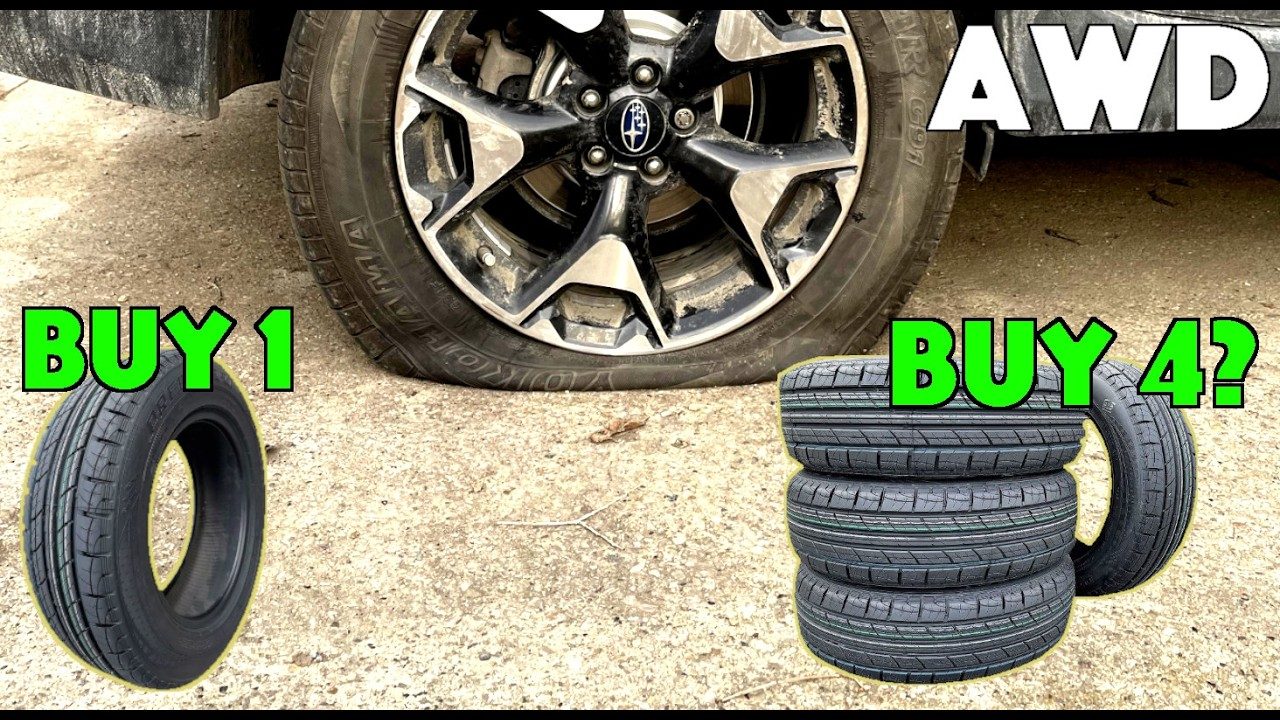
All-wheel-drive vehicles deserve extra caution when replacing a single tire. AWD systems can be sensitive to differences in tire circumference because the drivetrain expects the tires to rotate at closely matched speeds.
A significant difference between tires can make the system compensate for what it interprets as differences in wheel speed, potentially placing additional stress on components such as differentials and transfer cases. Michelin specifically warns that replacing one tire on an AWD or 4WD vehicle requires extra care.
This doesn’t necessarily mean an AWD vehicle always needs four new tires. The acceptable difference varies by vehicle; some manufacturers provide specific limits for tread-depth or circumference differences, while others may require all four tires to be replaced together.
For an AWD vehicle, the owner’s manual and manufacturer’s tire requirements should take priority over any general rule.
What If The Other Tires Are Worn?
This is where replacing one tire becomes much less attractive. If the other three tires are already significantly worn, installing one brand-new tire can leave you with an obvious difference in tread depth and rolling circumference. There are a few possible solutions:
- Replace all four: The simplest and most consistent option—albeit not the cheapest—when the existing tires are significantly worn.
- Replace two: On many vehicles, replacing a pair can be preferable to replacing just one. The newer tires are generally installed on the rear axle for better wet-road stability.
- Match the new tire’s tread depth: Some tire specialists can shave a new tire so its tread matches the existing tires.
- Replace one: This can work when the other tires are relatively new and the replacement closely matches them.
What Drivers Think About Replacing A Single Tire
Reddit’s tire communities tend to agree that replacing just one tire can be acceptable, but the answer depends heavily on tread depth and the vehicle’s drivetrain.
A 2026 r/tires discussion about replacing a damaged tire on an AWD Mazda CX-30 centered on the same question. With the remaining tires at roughly 5/32 to 6/32-inch tread, commenters generally recommended replacing all four rather than putting one brand-new tire alongside the worn tires.
Another recent thread involved a Toyota Corolla Cross Hybrid AWD with only about 10,000 miles. Redditors noted that a single replacement might be acceptable if the tires are still sufficiently close in tread depth, but stressed checking the manufacturer’s specifications.
The discussion gets even more complicated with AWD. In another r/tires thread, commenters pointed out that a new tire can potentially cause drivetrain issues if its rolling circumference differs significantly from the other three. Some suggested tire shaving as an option when the replacement tire’s tread is too deep.
The Reddit takeaway is pretty straightforward: don’t automatically assume one damaged tire means four new ones—but don’t automatically replace just one, either. Measure the remaining tread, match the tire as closely as possible, and check the manufacturer’s requirements, especially with AWD.
So, Can You Really Replace Just One?
Yes—but it’s not automatically the best choice. If one tire is damaged and the other three have plenty of tread left, a single replacement may make financial and practical sense. If the other tires are heavily worn, replacing more than one—or all four—is usually the better solution.
And if your car has AWD or 4WD, don’t guess. Check the owner’s manual or have a tire professional measure the tread and confirm what your vehicle allows.
The cheapest option at the tire shop isn’t necessarily the cheapest option for your car in the long run. A little attention to tread depth and tire matching can prevent handling problems, premature wear, and potentially expensive drivetrain repairs.