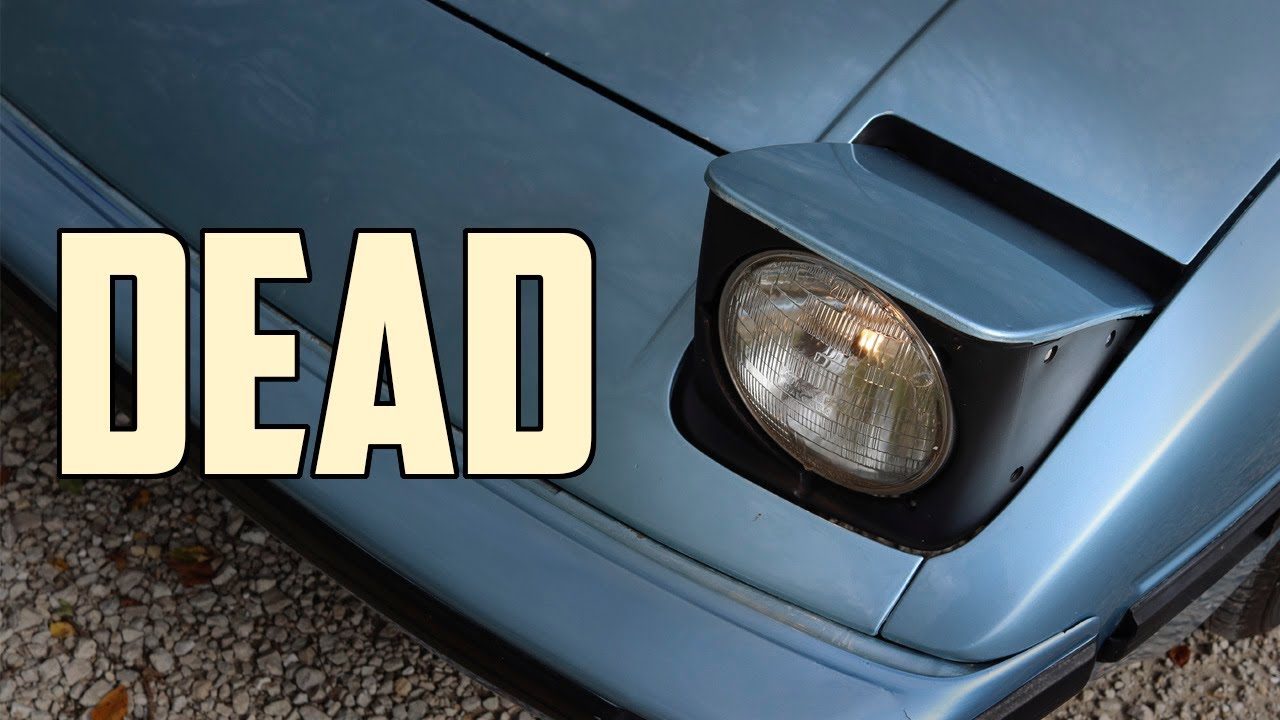
There was a time when flipping on your headlights meant more than simply illuminating the road. On cars like the Mazda RX-7, Toyota Supra, Ferrari F40, Porsche 928, and Chevrolet Corvette, switching on the lights caused two little doors to rise from the hood, revealing the headlights underneath.
Pop-up headlights were one of the defining design features of the 1980s and 1990s. They made ordinary sports cars look futuristic, helped designers create incredibly low noses, and gave cars a bit of mechanical personality that is almost completely absent from modern vehicles.
Then, seemingly overnight, they disappeared.
The last mass-produced cars sold in the US with pop-up headlights were the fifth-generation Chevrolet Corvette and Lotus Esprit, both of which ended production in 2004. Neither was directly replaced by another pop-up-equipped car, and the feature effectively vanished from the mainstream automotive industry.
So what happened?
Photo by: Sam Woolley | Motor1
Pop-Up Headlights Were Originally A Solution To A Problem
Pop-up headlights weren’t invented simply because designers thought they looked cool. They were largely a clever workaround for the lighting technology and regulations of their time.
Hidden headlights date back to the 1930s, with the Cord 810 among the earliest famous examples. But the feature really took off decades later, when automakers were working with large sealed-beam headlights and regulations that dictated what headlights could look like and where they had to be positioned.
That created a problem for sports-car designers.
A low hood was good for aerodynamics and styling, but a large headlight sitting on top of that hood wasn’t exactly attractive. The solution was simple: Hide the headlights when they weren’t being used.
When the driver turned them on, the headlights would rise into position.
It was an ingenious solution, and by the 1980s, pop-up headlights were everywhere. They weren’t limited to expensive exotics, either. Cars ranging from the Pontiac Firebird and Toyota Celica to the Honda Prelude and Mazda MX-5 Miata used them.
Then Headlight Regulations Changed
One of the biggest turning points came in the United States during the 1980s.
Changes to Federal Motor Vehicle Safety Standard 108 allowed automakers to move away from the traditional sealed-beam headlight format and use more sophisticated composite headlamps. Ford’s development of the aerodynamic Taurus is often cited as an important part of that shift.
Suddenly, designers didn’t have to choose between a giant rectangular headlight and a complicated pop-up mechanism.
They could design the headlight into the bodywork.
This opened the door to the weird, wonderful headlight shapes that became increasingly common during the late 1980s and 1990s. Projector lamps and, eventually, HID and LED technology allowed headlights to become smaller, more powerful, and much easier to integrate into a car’s shape.
Pop-ups had lost their primary reason for existing.
They Were Also Expensive And Complicated
A fixed headlight is relatively simple. A pop-up headlight isn’t.
A retractable system needs motors, gears, hinges, wiring, switches, additional bodywork, and a mechanism capable of repeatedly opening and closing the assembly throughout the life of the car.
And eventually, those parts wear out.
Anyone who has owned an older car with pop-up headlights has probably encountered the famous “winking” headlight: One side opens while the other stays shut. Sometimes the lights would refuse to retract. Sometimes they’d get stuck halfway.
That extra complexity wasn’t particularly attractive to automakers once inexpensive, compact headlights could accomplish the same basic job without moving at all.
For manufacturers trying to reduce cost and improve reliability, there wasn’t much reason to keep the mechanism around.
Why Pop-Up Headlights Disappeared
- Headlight regulations changed, allowing smaller and more flexible composite lighting designs.
- Lighting technology improved, making compact projector, HID, and eventually LED headlights possible.
- Pop-up mechanisms added cost and complexity compared with fixed headlights.
- Aerodynamics improved, making flush-mounted headlights more desirable.
- Pedestrian-safety regulations made protruding components more difficult to engineer.
- Car design moved away from the wedge-shaped styling that made hidden headlights so popular.

Pedestrian Safety Was The Final Nail
This is where the story gets a little more complicated. You may have heard that pop-up headlights were “banned.” That’s not really accurate.
There isn’t a simple US law that says a car cannot have pop-up headlights. In fact, Motor1 previously spoke with Audi lighting-development executive Dr. Michael Kruppa about the possibility of bringing the feature back, and the bigger issue is how difficult it would be to engineer a modern system that meets today’s requirements.
The problem is what happens when the headlights are raised.
A modern car’s front end has to be designed with pedestrian impacts in mind. A raised headlight assembly creates hard, protruding surfaces that can make those requirements much more difficult to satisfy. European pedestrian-protection regulations in particular played a major role in making the traditional pop-up design increasingly impractical.
Pop-up headlights weren’t simply outlawed. They became a pain in the neck to engineer.
And once automakers had cheaper, lighter, more aerodynamic fixed headlights available, there wasn’t much incentive to spend the money required to make pop-ups work.
Modern Cars Have Their Own Version Of Pop-Up Headlights
Interestingly, the basic design idea hasn’t completely disappeared.
Modern cars increasingly use split headlights, where a narrow daytime-running light sits near the hood while the actual headlamp is hidden farther down in the bumper.
Audi’s Dr. Kruppa described this approach as a way of visually hiding the main headlight assembly. The driver gets the distinctive appearance of a thin, almost invisible lighting element during the day, while the actual low- and high-beam hardware sits somewhere else.
It’s not the same thing as watching a pair of headlights physically rise out of the hood.
But aesthetically, it’s not that far removed from the original idea.
The difference is that modern designers can achieve the look without adding motors and hinges to the front of the car.
People Still Want Them Back
If there’s one thing Reddit makes clear, it’s that pop-up headlights haven’t lost their appeal with enthusiasts.
A thread on r/cars asking why pop-up headlights aren’t still around generated plenty of discussion about pedestrian safety, cost, aerodynamics, and modern lighting technology. One commenter summed up the prevailing attitude pretty well: the technology could probably be engineered into a modern car, but there’s little practical reason for an automaker to do it.
Another r/cars discussion specifically asked whether pop-up headlights could be redesigned to make them safer. Commenters suggested alternative mechanisms that could reduce the potential pedestrian-safety issues, although others pointed out that modern lighting technology has largely eliminated the original reason for using retractable headlights in the first place.
Could Pop-Up Headlights Ever Come Back?
Technically, probably. Practically, it’s hard to imagine.
Pop-up headlights aren’t inherently illegal, but designing a modern system that satisfies today’s lighting, pedestrian-protection, durability, packaging, and aerodynamic requirements would be considerably more difficult than simply installing fixed LEDs.
There have been a few attempts to revive the idea. The Ares Panther, for example, used retractable headlights on a modernized Lamborghini Huracán-based design, while Mazda’s Iconic SP concept showed that automakers are still willing to play with the idea of hidden lighting.
But there’s a big difference between putting pop-up headlights on a low-volume exotic or concept car and putting them on a vehicle that has to be produced in the hundreds of thousands.
That’s ultimately why the pop-up headlight disappeared.
It wasn’t one regulation, one lawsuit, or one meeting where automakers collectively decided that pop-up headlights were no longer cool. The world simply changed around them.
Better lighting technology made them unnecessary. New safety requirements made them harder to engineer. Modern aerodynamics made flush-mounted lights more desirable. And consumers eventually got used to headlights that stayed exactly where they were.
Still, there’s something undeniably charming about them.
A modern LED headlight can be brighter, smarter, more efficient, and dramatically more capable than the headlights on a 1980s sports car. But it can’t wink at you.