Brakes are the most critical system on a car. The fact that your car can stop on a dime every time, without drama, is taken for granted by nearly every driver on the road today. But it comes down to one technology: Anti-lock brakes (ABS).
Once a highly coveted option, ABS is now fully ubiquitous (and mandatory) in all new cars sold in the United States. And it might be the single most important safety technology since the three-point seatbelt.
Anti-lock brakes were invented to counter the phenomenon of wheel lockup. Instead of your wheels locking up and forcing the vehicle to go straight, ABS would pulse the brakes automatically, allowing the wheels to continue rotating and allowing control over the vehicle in all conditions.
It sounds complicated, but ABS is actually a relatively simple and ingenious system. Motor101 is here to explain.
What Are Anti-Lock Brakes (ABS)?
In simplest terms, anti-lock brakes are a safety system that prevents a vehicle’s wheels from locking during hard braking. By rapidly applying and releasing brake pressure, ABS helps drivers maintain steering control while stopping as quickly as possible.
The Origin Of Anti-Lock Brakes
Like many great automotive technologies, ABS comes from aviation. On airplanes in particular, it’s difficult to gauge brake feel—basically the intuitive sensation of how much you can push the brakes before locking up. But it was nothing like the ABS we know today.
The original ABS was a complicated mechanical system rather than the relatively simple electronics of today. It wasn’t until the 1970s that electronics got good enough to run ABS calculations, and we started seeing versions of what would become modern ABS.
The first cars to get ABS were American-made, with anti-lock systems for the rear wheels only. It wasn’t until the 1978 Mercedes-Benz S-Class that four-wheel ABS became a thing, and it revolutionized the industry. Bosch made the system for Mercedes, which they promptly packaged into a modular system for a variety of different cars.
Since that original system, which basically just prevented the wheels from locking up, ABS has become an integral piece of vehicle software and hardware. Now, most systems are practically seamless, allowing for smooth panic stops that maximize available grip.
If you’ve ever driven an old car and had to engage ABS, you’ll know that it was loud, jolty, and generally rough. These days, ABS is smooth and has a few clever tricks up its sleeve in terms of handling.
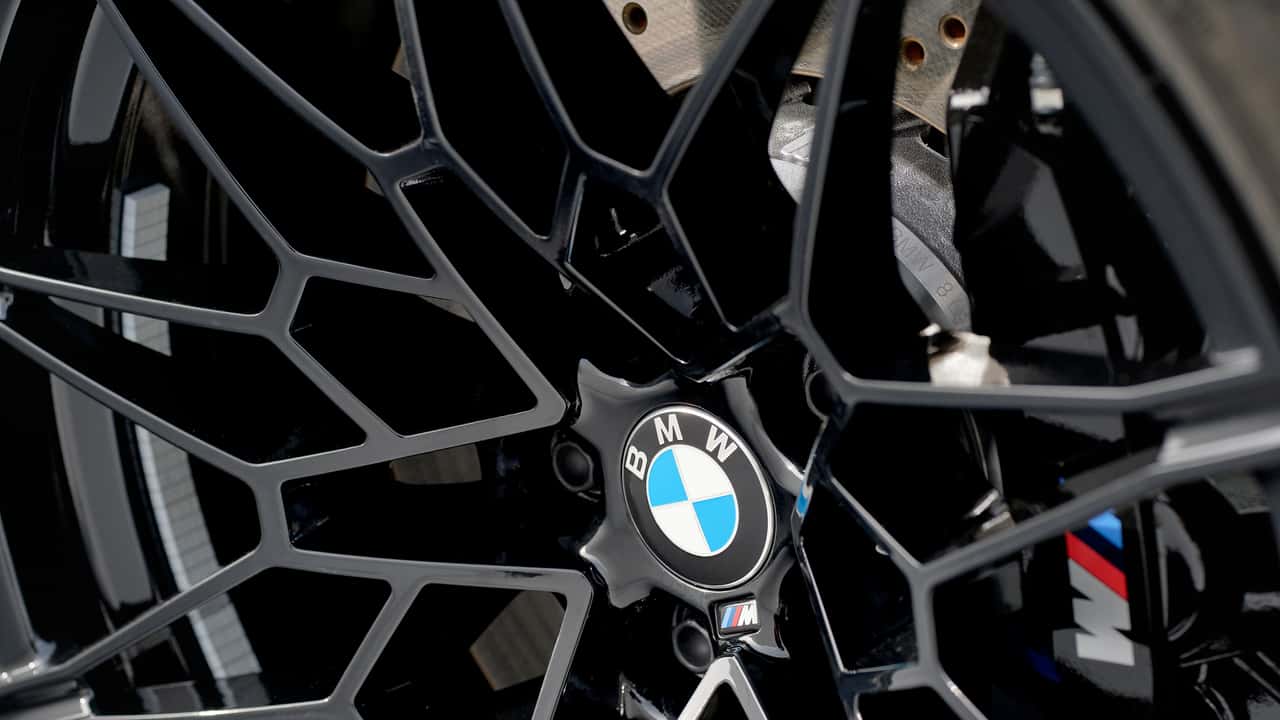
BMW M3 Brakes
Photo by: BMW
How ABS Works
In principle, ABS is incredibly simple:
Wheel sensors monitor speed
The ABS computer detects impending lockup
Hydraulic valves reduce brake pressure
The system reapplies pressure repeatedly
The driver maintains steering control
Depending on the system, there could be two to five sensors detecting the amount of pressure you’re applying to the brakes. All that info is fed into the ABS computer, which calculates where to cut brake pressure when it senses a lockup, based on the difference in speed between wheels.
Powering the whole thing is an electro-hydraulic pump and a series of solenoid-controlled valves. For a given ABS, there are generally two valves per wheel.
One valve controls and maintains the amount of fluid and pressure that gets to the caliper, and another valve releases brake fluid into an accumulator, which is basically a storage tank. Those valves are partially what you hear when ABS engages, which could sound like banging or rhythmic tapping.
The valves do the actual work of preventing the wheels from locking up, while the pump just allows the system to pump brake fluid back into the calipers to reapply braking force. It all runs in a cycle that increases then decreases brake pressure rapidly enough that the wheel slightly locks, releases, and tries to lock again within milliseconds.
Modern ABS adds a couple of twists to that sequence.
Practically every car sold today is equipped with electronic brake force distribution, which allows the ABS computer to send more (or less) brake pressure to specific wheels based on how much grip is available. In the most basic sense, it looks for how much slower a wheel is spinning, as well as steering angle and G-force, to decide whether a tire has more grip than the brakes are using.
The Bottom Line
ABS is a foundational safety technology that has saved countless lives, and it all works relatively simply. The fact that the majority of cars on the road today have functioning ABS is a testament to the system’s simplicity and brilliance.
Without ABS, accidents would be much more prevalent, and our roads would be substantially less safe. And regardless of what you drive, all of us have benefited from its existence.
FAQs
It’s because of the ABS pump and valves opening and closing rapidly as it works to prevent any lockups. Also, every time ABS cycles, there is a tiny lockup that can cause a resonance through the suspension.
An array of sensors measure how fast the wheels are spinning and detects when a lockup (e.g., the wheel isn’t spinning) occurs. Then, a pump and a series of valves can rapidly remove and reapply brake force to the wheel that locks up until the wheel is spinning at the correct speed.
Because you can maintain control of the vehicle at maximum braking without fear of a lockup. Cars not equipped with ABS maybe lock easily and you can lose control of the vehicle without the correct reactions.
Yes, ABS is very reliable, and there are legal requirements for ABS systems that will alert the driver if any failure or fault has occurred. Of course, like any system, it can break. But if there are no warning lights on the dash, it’s likely in good working order, and a diagnostic scan will reveal any trouble codes.
It depends on the ABS system. Generally, it is better to threshold brake to maintain precise control, but ABS can and will save you from small errors.
Why Every BMW Has That Signature Rear Window Kink
The Three Types Of Automatic Transmissions—And How They Actually Work
Why Some Cars Put Power Down Better Than Others
AWD Vs 4WD: What’s the Difference And Which One Do You Need?