Acquiring a GR Yaris from Toyota’s mysterious mid-Tokyo parking lot was the first time in a long time I felt anticipation about a loaner car.
I’ve spent years wanting to drive a GR Yaris. It was the first expression of Gazoo Racing as an enthusiast brand, and it was a proper Toyota, unlike the BMW Supra that debuted alongside it. The difference in reverence was obvious—the GR Supra was celebrated but never quite loved by Toyota. The GR Yaris, like all great cars, had something beyond itself. An irrational objective, destined to be an art form rather than a spreadsheet-pleaser.
Photo by: Chris Rosales / Motor1
Akio Toyoda himself authorized the project. The official story was for World Rally Championship homologation; Toyota discontinued the normal three-door Yaris due to low demand, leaving the five-door version as the only one in production. Toyota’s world rally team said the five-door is less than ideal for maximum competitive potential, so a study into making a homologation special was undertaken, with all the accouterments that come with it.
Gazoo Racing developed an all-new three-door bodyshell, which shared almost nothing with the standard Yaris. The rear structure was heavily reinforced and reconfigured to accommodate the Corolla’s semi-trailing-arm rear suspension and a new rear differential. The fenders were widened 2.4 inches front and rear, and the roof was lowered about 1.8 inches above the driver, and 3.7 inches toward the rear of the car.
In the process, dozens of details were engineered to increase rigidity: feet of structural adhesives, small, triangulating braces underneath the body panels, and a carbon fiber roof. All in the name of rally homologation, though Toyoda later admitted the depth of the GR Yaris’ development could have only been possible as a passion project. Like the Lexus LFA he helped foster a decade earlier, he wished to see the ultimate Toyota, something to reflect the pride and craftsmanship Japan is so well known for.
In the six years since the GR Yaris’ debut, it has seen continuous and loving upgrades. Every year, a small change. A slight change in damper tuning. An even smaller change in spring rates or sway bar thickness. Two years ago, the angle of the rear trailing arm was adjusted slightly for more anti-squat, adding more pitch stiffness for a slightly better entry-mid and exit-out cornering attitude.
Then, bolts. Chief Engineer Sakamoto Naoyuki painstakingly developed better bolts to increase chassis rigidity, adding small flutes between hex heads, slightly thicker bolt flanges, or even choosing a new bolt material entirely. The engine team developed a new material for the exhaust valves that could handle even more thermal abuse, while further strengthening the valvetrain.

Photo by: Chris Rosales / Motor1
The gray 2026 GR Yaris RZ High Performance that I was now streaking across Kanagawa in is the amalgamation of those details. The LFA’s development echoes powerfully with that of the GR Yaris: an unbelievable product of iteration and careful, considered engineering. Nothing about it will blow you away, but the tiny details, like the high-fidelity murmur of chassis feedback, the Porsche-esque linearity and precision to the steering, and the exact rate at which the RPMs drop between shifts, are all judged to exacting perfection.
In short, it was the ideal weapon. It’s a perfect representation of what Japan brings to sports cars. A celebration of obsession, iteration, and emotion over raw numbers. It’s so anti-European in the same way a Honda S2000 is, so against what is considered conventionally “good” or “right,” that it’s more of a thesis than a consumer product.
I set off on what would become my favorite adventure in Japan. I sought something more than last year’s Honda N-One RS road trip. I wanted to find the core of Japanese driving culture, beyond what Initial D dramatized. Leaving Tokyo on the very expressways that I was obsessed with as a teenager, I set off for a rural mountain town called Hakone.
Photo by: Chris Rosales / Motor1
Kanagawa
Hakone is one of my favorite places in the world. Not just for the driving roads, but because it and the surrounding areas are places of incredible natural beauty. It’s within the wider Kanagawa prefecture, which contains miles of some of Japan’s prime coastline, mountains, and most of the city of Yokohama.
It’s also the home of Japan’s most well-known driving road: the Hakone Turnpike. Decades of motoring media surround the place. Once upon a time, a magazine held a yearly hill-climb competition up the road, immortalized on the pages of the internet and on YouTube. It’s the jewel road of the mountain range, but many other great roads branch from it.
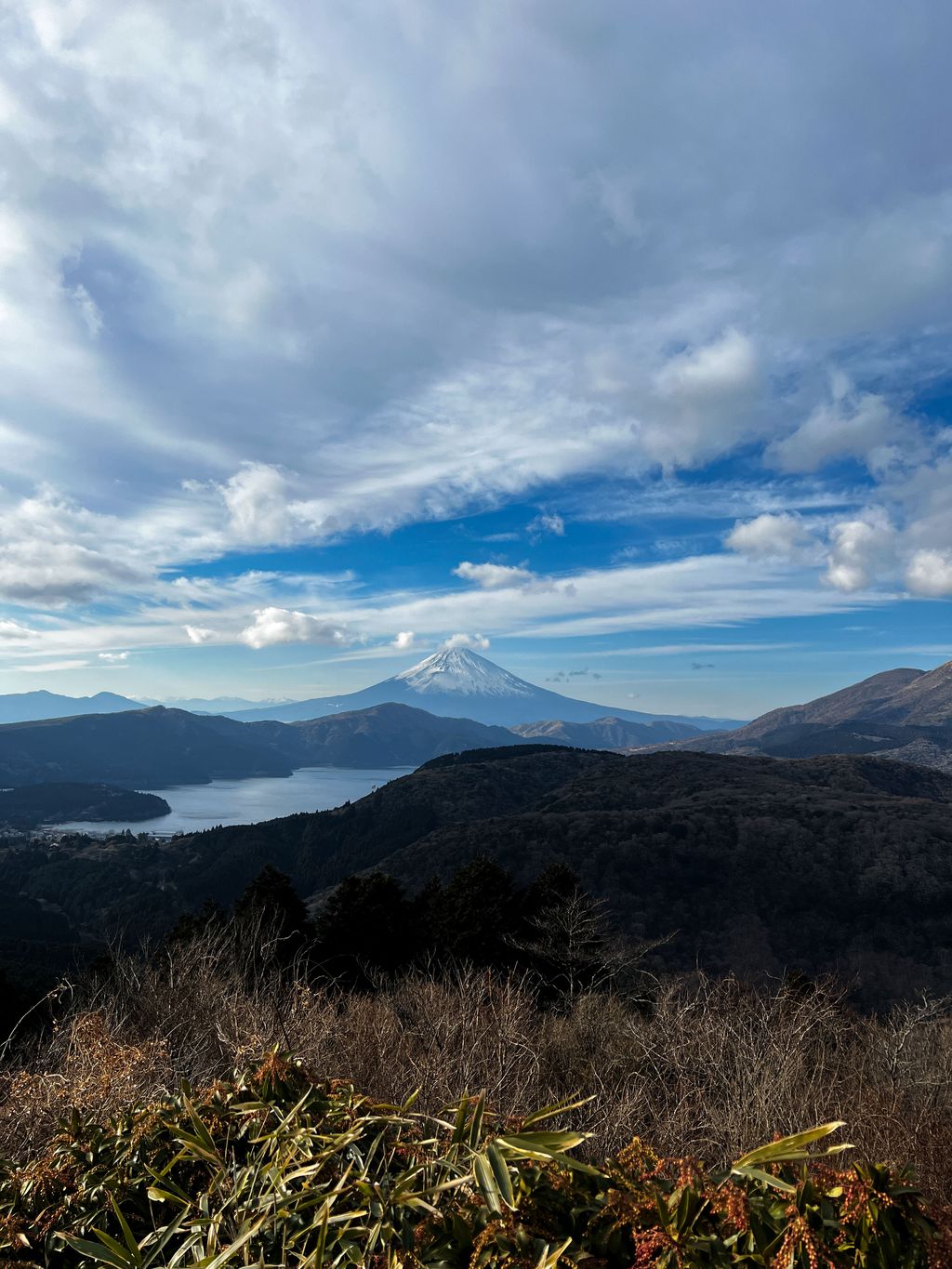
The view from the Mount Taikan observation deck.
Photo by: Chris Rosales / Motor1
I drove up the back way, up from Lake Ashinoko, after spending the night in town. I knew exactly where to go: The Mount Taikan Observation Deck. This is where I estimated the spiritual center of driving culture would be, like a Newcomb’s Ranch for Angeles Crest or Deals Gap on Tail of the Dragon. It has the key elements: a sizeable parking lot, instant road access, and stunning views, all offering ample opportunities to absorb existence.
Handsomely rewarded, I was. Immediately upon pulling into the parking lot, I saw a white GR Yaris and a man standing beside it. I parked politely next to him (with a one-space gap, of course), and his eyes immediately lit up. Upon exiting my gray Yaris, he approached my car and examined the front end. Parsing through the very little Japanese I knew, I picked out from the stream of words “furontobanpa” and understood that he was asking about the new front bumper.
Photo by: Chris Rosales / Motor1
Through a translator app, we spoke for about 10 minutes about our cars. His excitement was palpable, and I asked him if people came here often to drive. He gave me a simple “yes” and explained that it was very popular, even for people who live in Tokyo, to spend the day driving here.
As we spoke, a Lamborghini Temerario drove past from the turnpike, as did a Lotus Evora. A gorgeous panda AE86 parked at the lot across from us, then a straight-up takeover-style Dodge Challenger also pulled in. Within 15 minutes, the mix was eclectic, alongside your typical Porsche 911 GT3s.
Somehow, even the stuff I’m used to seeing back home was just better. Maybe it’s the clean, monochromatic Japanese license plate. Or how every car in Japan is somehow impeccably clean and well cared for.
Photo by: Chris Rosales / Motor1
My new friend, who also happened to own an S2000, had to go. So I finally could set out along the drive route I planned, heading northeast down the turnpike, back up, then heading east down the Tsubaki Line, which then doubled back to the northwest, taking me to the Ashinoko Skyline, where my drive would conclude.
Touge
The Hakone Turnpike, formerly the Mazda Turnpike, was built in 1955 as part of Japan’s original National Route 1. It has long since been bypassed, but it remains accessible as a toll road and serves as something of a spiritual home for drivers in the Hakone mountain range. Toyota, in a fit of patriotism, I’m sure, named its limited production green-shaded 86s after the road: Hakone Edition. Oddly, they only ever called it that in the United States. In Japan, they are simply known as Ridge Green Limited.
Photo by: Chris Rosales / Motor1
It’s a road with colossal speed potential. The minimum radius for a given corner is 100 meters, or about 328 feet. Angeles Crest Highway, which is also considered a “fast” road, has a minimum radius of 200 feet. It’s also ridiculously wide. Two cars could fit in a single lane, side by side. For a speed limit of 50 km/h, it is quite overkill, to say the least. It’s also incredibly empty at all times, with minimal traffic and parked cars.
Among the other roads in the system, it is an oddity in its width and speed. It’s perhaps the only road in Japan I’ve ever driven that takes real speed to get a jog going. The rest are more like the next roads: tight, twisting, and narrow. The turnpike also went by in a flash, and soon I was back at Mt. Taikan, making a left onto the Tsubaki Line.
This is where the going got good, and I could explore the Yaris properly without committing a Nipponese felony. The speed limit was the same 50 km/h, but the smallest radius was about 75 feet, making for unbelievably tight turns. This was Yaris country.
Photo by: Chris Rosales / Motor1
First and foremost, weight. The GR Yaris RZ manual, astoundingly, weighs just 2,822 pounds, the same as the lightweight, rear-wheel-drive GR86. For comparison, an equivalent GR Corolla weighs 3,274 pounds. 452 pounds is nothing short of transformative, and it radiated throughout the experience. The G16E turbocharged three-cylinder, which felt encumbered in the Corolla, felt wildly overbearing in the Yaris. After a moment (or three), the turbocharger would spring to life like it missed an appointment, and the aggressive ramp in thrust would force all four tires to scrabble for traction. With all three limited-slip differentials, it would never struggle much, but it would communicate a bit of life to the driver, where the Corolla was dampened and muted.
All the joys that come with being lightweight were present in the Yaris. Transitions, of which there were plenty on the Tsubaki Line, along with complex compounding corners that forced rapid transitions from full throttle to heavy braking and steering, challenged the Yaris’ attitude in all situations.
Though it was unflappably fastened at the rear, offering very little joy in terms of yaw, its manners and control were undeniable. It practically demanded an E-brake pull, though I didn’t feel like spending a night in JDM prison. Snapping the throttle shut, beginning the gentle squeeze toward peak brake pressure with its stout, short pedal, and rolling the weighty, surprisingly talkative (for EPS) steering toward the apex, became metronomic. Each and every response was consistent, repeatable, and pleasurable. Shifting with my left hand proved a delight for my brain, too.
Scrabbling onto the Ashinoko Syline brought a welcome reprieve from the forested Tsubaki. It was more open, straddling the ridge west of Lake Ashinoko, and its corners were more flowing and less technical. My appreciation for the Yaris slowly became an adoration.
What Is A Hot Hatch?
Photo by: Chris Rosales / Motor1
Mount Fuji soon commanded my view, watching me vigilantly. In the little hatchback, along a beautiful and winding mountain road, I found many of the answers I was searching for. “This car,” I thought, “is proof.”
Proof of essence over matter. Proof that sports cars are made in character and not in numbers. The GR Yaris has the essence, the granularity in detail, and the driving character to be amongst the greats. I long thought that the GR86 may be the best sports car on sale today, but the Yaris displaces it handily.
Finally closing in on my destination, which is a parking lot I only know from a few frames from Initial D: Fifth Stage, I felt a genuine lament that I couldn’t bring the Yaris home with me. It was functionally perfect. It felt ragged in a way that most cars no longer feel. It was small and lightweight, fitting just enough for a driver and a passenger, and two amputees. Parking it and getting out to absorb more of its form factor only drove the point home.
It has the ingredients of greatness. A unique bodyshell developed only for racing. Absurd, distorted proportions that ache with purpose. Fabulously complete calibration. Lovingly developed driving character. And it feels special to sit in, with its lowered roofline and unique 80s-style dashboard consistently reminding you that you are in a GR Yaris, not just any old Yaris.
Photo by: Chris Rosales / Motor1
The agony that the engineers went through to develop such a complete object is clear. And while I could finally eat the egg salad sandwich I stashed in the glovebox and stare at Mount Fuji, I was satisfied that I found what I set out to discover.
The GR Yaris is everything I hoped for. And while an Alpine A110S streaked past my turnout, followed by a pack of Porsche 911s, I found where Japanese enthusiasts want to drive, too.