Now that car companies have reported their first-quarter sales, we can definitively say it was a rough start to the year for the U.S. electric car market. Here are five takeaways to help wrap your head around the EV space right now:
EV Sales Were Way Down From Last Year, Again
Americans bought some 216,000 new electric cars in the first three months of 2026, according to Cox Automotive’s latest estimates out Friday. Sales plunged by 27% on a year-over-year basis, after dropping 36% in the previous quarter. In terms of overall quarterly sales volume, the EV market has been set back to about late 2022.
Photo by: InsideEVs
All the policy whiplash has dealt a one-two punch to the electric market—by dampening consumer interest in EVs and eliminating much of the pressure for carmakers to sell them. Car companies are now teasing out where the new normal for EV demand will land without tax credits.
But Things May Be Stabilizing
Electric car sales skyrocketed during Q3’s rush to claim the expiring EV tax credit, resulting in over 10% EV market share that quarter. Then sales crashed by some 46% in Q4. But EV share has been flat at around 6% over the last two quarters, suggesting that the worst of the fallout is behind us.
“EV sales in Q1 were lower by 7.8% compared to the previous quarter, an improvement and suggesting the sales drop after government-back incentives were terminated has slowed,” Cox analysts wrote on Friday.

The 2026 Toyota bZ was an unexpected winner of Q1, becoming the country’s best-selling non-Tesla EV.
Photo by: Patrick George
Zeroing in on the EV market without Tesla also helps paint a richer picture of what’s going on; Tesla somewhat tracks with the broader EV world but is also its own animal. Non-Tesla EV sales rose 3% quarter-over-quarter to 99,099 units, according to Cox’s data. That’s not a huge increase. But it’s a whole lot better than the 63% free fall this slice of the market experienced between Q3 and Q4 of last year, and it suggests some recovery may be underway.
Most Brands Crashed, But Some Won Out
Most brands saw EV sales drop in this rockier environment, but some fared better than others. Stellantis experienced well over 80% declines across the Fiat 500e, Jeep Wagoneer S, and Dodge Charger EV. (Taken together, it sold under 500 of those models combined.)

Audi’s EV sales plunged by nearly 90%. Honda fell 65%. Kia was down by nearly 40%, according to Cox’s estimates. The company has told InsideEVs that it has prioritized combustion-vehicle production at a plant that makes both gas-powered cars and EVs. Chevrolet fell by 30%; while the Equinox EV held fairly strong, sales of the pricier Blazer EV fell by over 5,000 units to just over 1,000 vehicles sold.
Cadillac, meanwhile, was up by about 20% in Q1, the result of a large and growing lineup. Rivian’s sales also rose year over year. Hyundai managed to stay just about flat, after it slashed the price of its Ioniq 5 by nearly $10,000. Some of the companies that were most committed before are very much still in the game. And the models that have remained competitive in the new policy environment—some through increased incentives or price cuts—continue to sell well.
Tesla Is Grabbing Share
For years, Tesla’s market share steadily eroded as the overall market for EVs in the U.S. grew. Tesla’s pivot away from cars accelerated that trend. Now the opposite is happening. As the EV market contracts, Tesla is gobbling up share despite its own flagging sales.
In Q4 of 2025, Tesla’s slice of America’s electric market shot up above 50% for the first time since 2024. In Q1, it claimed 54.2% of America’s EV sales, Cox says, up from 43.2% during the same period last year.
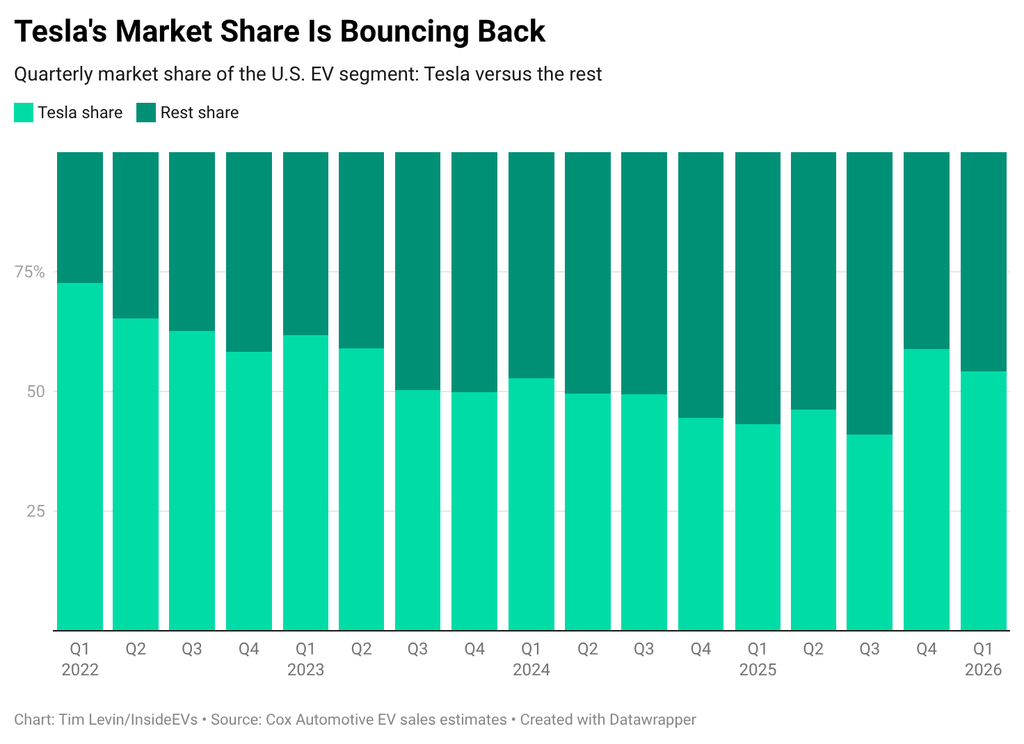
Photo by: InsideEVs
It all signals that Tesla is better equipped to weather the end of the tax credit than some rivals. But there’s another reason to expect this: Unlike legacy players, Tesla doesn’t have combustion vehicles it can shift resources toward in response to the removal of clean-car regulations. And it wouldn’t necessarily want to; also unlike the old guard, its EVs are profitable.
Still, it was not a great quarter for Tesla. While its global deliveries rose slightly, its U.S. vehicle sales fell by 8.4%, according to Cox, due largely to the Model 3’s worst quarter in years.
Toyota’s Fast-Follower Strategy Is Working
Toyota was a sneaky winner of Q1. Sales of the bZ nearly doubled year on year, surpassing 10,000 units and cementing Toyota’s crossover as the country’s best-selling non-Tesla EV. Toyota has been aggressive with its incentives, and the bZ was much-improved for the 2026 model year, making this a great value. Toyota snatched the “best of the rest” crown from Chevy Equinox EV.
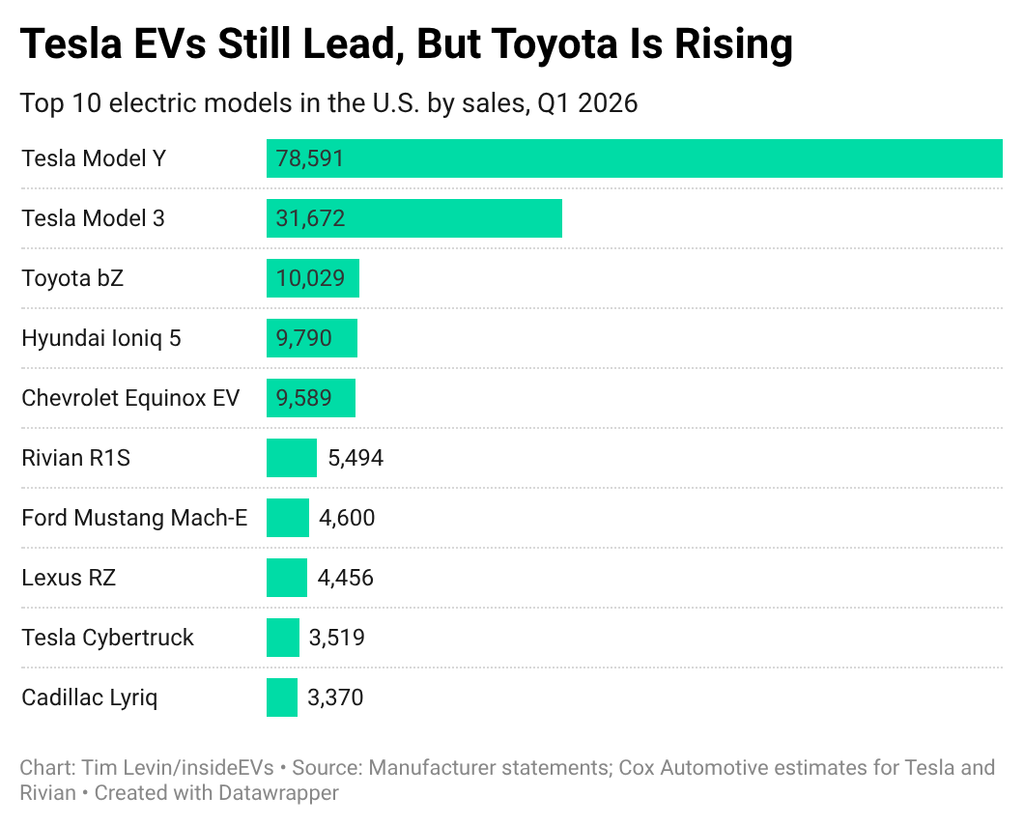
Photo by: InsideEVs
So, where will things go from here? In part, it depends on the auto companies themselves. Especially with the tax credit out of the picture, being aggressive on EVs generally means taking a hit to margins in the near term.
There are other headwinds and tailwinds I am watching too. Dealer stock of the many EVs that were discontinued recently will dwindle this year, dragging sales down. High gas prices due to the war with Iran could nudge some buyers toward EVs, but the broader economic impact may cancel that out.
Over the coming months, the pull-ahead effect from Q3 will dissipate as more buyers enter the market. The ongoing rise in used EV sales—driven by a flood of modern, off-lease cars—will help get more price conscious buyers to make the switch, but the impact of that on new vehicle sales will be more of a slow burn.
In the near term, high-tech, well-priced new models like the BMW iX3 and Rivian R2 will potentially give a boost to both volumes and vibes. Over the long term, expect new vehicles, falling costs, and—potentially—the return of federal support to lift EV sales.
Contact the author: [email protected]