- Consumer Reports ranked the real-world highway range of 27 electric cars.
- It found that many brands were within a few miles of their advertised EPA range.
- Some blew past their EPA ratings, even when traveling at 70 mph.
Nobody likes being range-baited. That is, finding out your electric car can’t live up to its EPA estimate. The opposite, though? That’s a nice surprise.
Naturally, EPA ratings don’t always match up to real-world range. Because the real world has weather, lead-footed drivers, and other complications that don’t show up in lab testing. This is why outlets like Consumer Reports have a set of their own tests to evaluate just how close an EV can match up to its official numbers.
For its latest analysis, the organization drove nearly 30 EVs at 70 mph until they couldn’t go any farther. The idea was to see how different cars stack up to their EPA ranges during highway road trips. Some brands consistently blew past their rating, while others fell short.
There’s one quick caveat we should get out of the way before diving into the winners and losers. The EPA’s range estimates include a mix of city and highway driving. So it’s not at all surprising for a car to fall short at highway speeds. On the flip side, far exceeding an EPA estimate at 70 mph is a notable achievement.
Photo by: BMW
Let’s start with the overachievers. At the top of the list is BMW which achieved an average range delta of 18.6% higher than its government-supplied numbers. Consumer Reports tested both the BMW i4 M50 and BMW i5 M60, which scored 18% and 19.1% higher (respectively) than the EPA range. The i4 achieved 51 extra miles of range (318 real-world miles versus its rated 267), while the i5 also hit a respectable 45 miles over its on-paper numbers (295 miles versus 250 miles).
BMW was followed by Mercedes-Benz and Mini. The two models tested from those brands landed at 12% higher than estimated (31 and 25 more miles, respectively). Overall the Germans topped the charts by exceeding their EPA stated range by a whopping 9.7%. And since Mini is part of the BMW Group, we can chalk that up as another win for BMW.
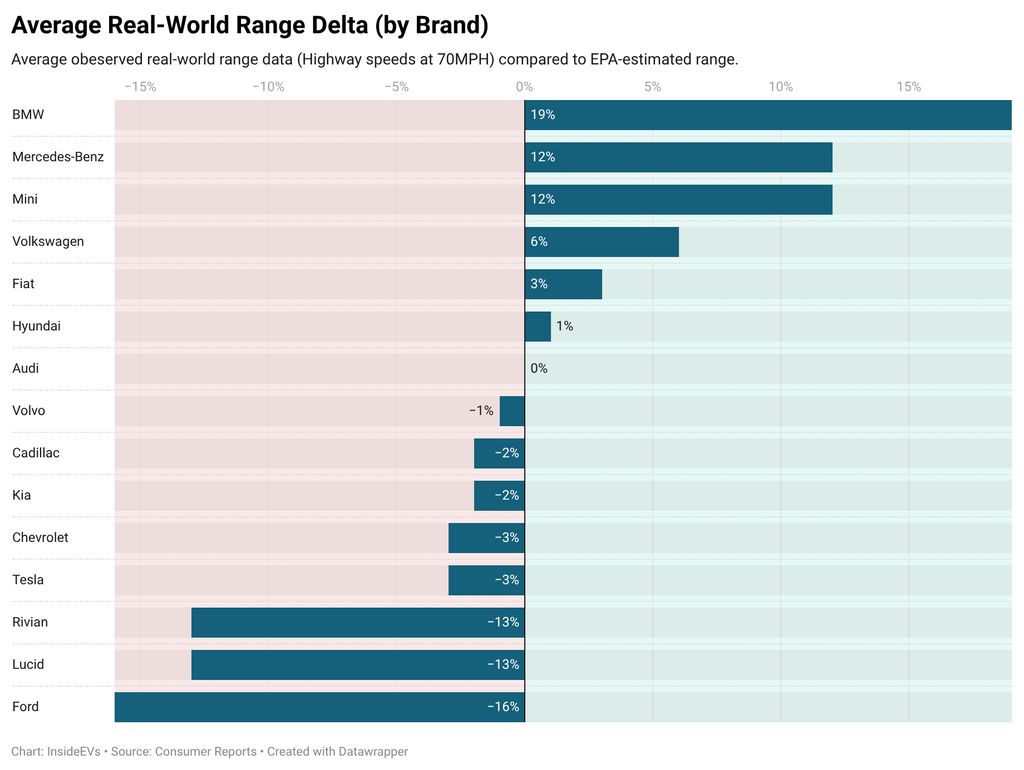
Consumer Reports compared each EV’s 70-mph range with its EPA-estimated overall rating.
Photo by: InsideEVs
South Korea came in fairly neutral at just -0.6% less range in real-world highway testing compared to the EPA-estimated range. The Kia EV9, Hyundai Ioniq 9, and Hyundai Ioniq 6 all stayed fairly true to their EPA numbers. The Ioniq 5N achieved an extra 15 miles (6.8%), but was dragged down by the Kia Niro which failed to meet the mark by 14 miles (-5.5%).
Then comes America, which was all over the chart.
Tesla managed to score a win with the Cybertruck and Model Y Long Range, besting the EPA numbers slightly. But it Model 3 Long Range and Model S did those numbers no favor. In fact, the Model S Long Range missed the EPA figures by 44 miles (10.7%).
At the bottom of the list—Model S aside—were four more domestic players. The Chevy Silverado EV was 21 miles short of its target, followed by the Ford F-150 Lightning at a deficit of 50 miles. But the real under-performers in Consumer Report’s test were the Rivian R1S and Lucid Air Touring which both had 52 fewer miles than expected. Again, this doesn’t mean these vehicles “don’t meet their EPA estimate”—but rather that they don’t exceed it like some other models can.
The full chart of all 27 tested vehicles tested by Consumer Reports is below.
Perhaps the most surprisingly takeaway for me is just how many vehicles came pretty darn close to their EPA-rated mileage or exceeded it, despite the nature of the Consumer Reports test. So, sure, maybe you want to go out and look at a used BMW EV because of the numbers in the test. And you could probably get a great deal on a used BMW i4 soon, as that’s replaced by the more advanced i3. But, judging by this test, there are plenty of EVs that can go the distance.