An avalanche of Chinese brands is due to set up shop in the UK in 2026 and targeting the mainstream market. Given that news, Stellantis’ British operation might appear to be more exposed than many, with its Citroën, Fiat, Jeep, Peugeot and Vauxhall brands in particular all needing to compete in segments where new tech-savvy, price-conscious and quick-to-market Chinese rivals are now swimming and aiming to grab sales and share.
But as an early statement of intent – or perhaps a gauntlet laying down – the Stellantis Group’s showing at the January 2026 Brussels Motor Show was impressive. Across a 5,200 sq m exhibition space – basically a large portion of Hall 5 – Stellantis displayed 62 vehicles from 11 marques with all its brand CEOs in attendance at an expo which is rapidly being tipped to switch up from a local market also-ran to a potential Geneva Motor Show replacement.
With two of the Group’s cars – the Fiat Grande Panda and Citroën C5 Aircross – making the ‘final-seven’ shortlist for the European Car of the Year award announcement now held at the event (and which used to be held at Geneva before that show stopped in 2024), the Group’s presence at the Belgian expo represented a definite show of strength.
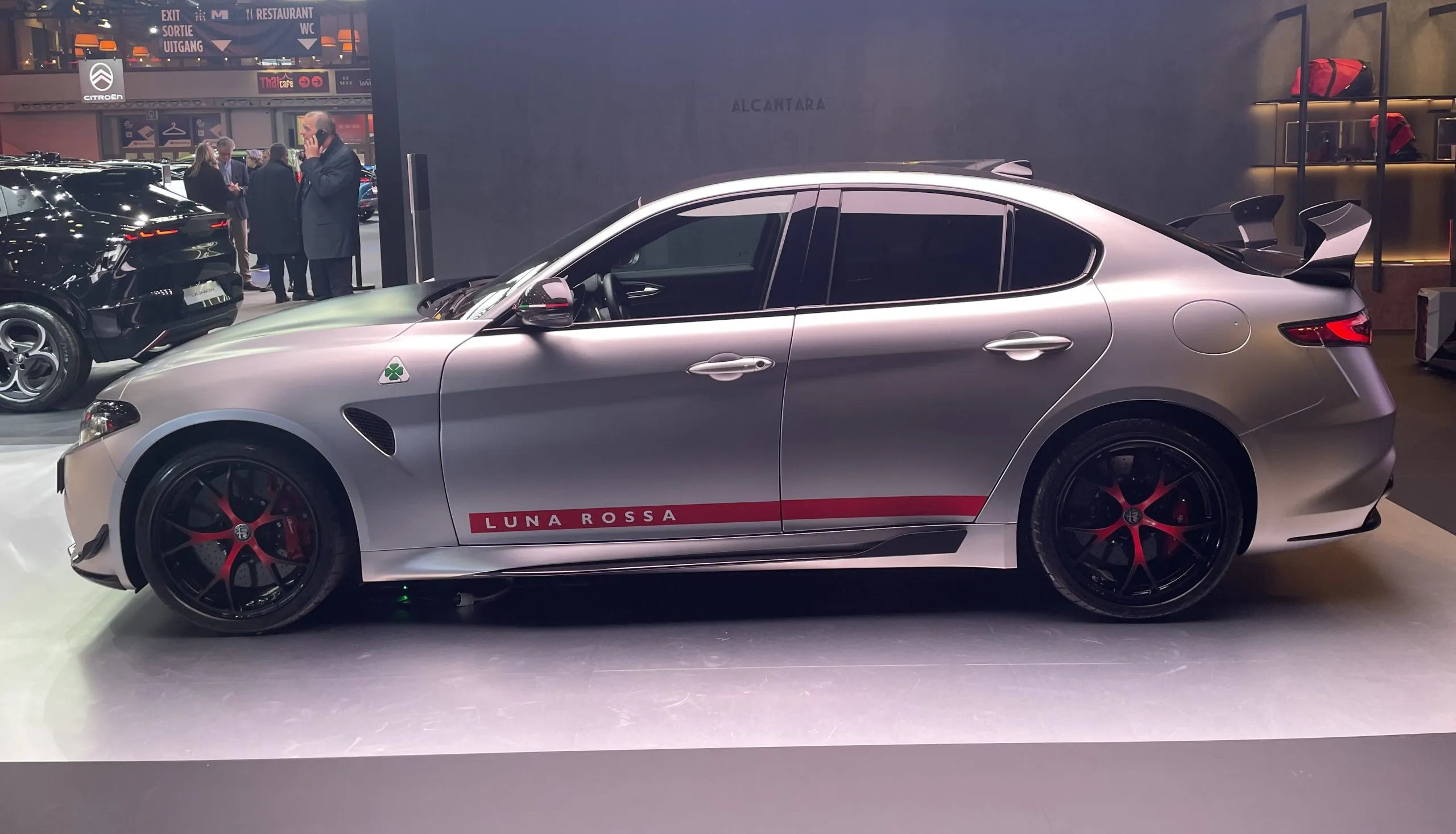
At the top end of the market Stellantis revealed the extremely aerodynamic and limited edition – one of ten only – Alfa Romeo Giulia Quadrifoglio Luna Rossa (price tbc, but all cars are already accounted for with customers) and in the mid-market there was the convincingly refreshed world premiere of the Peugeot 408 production fastback.
In the conceptual sphere Stellantis rolled out the innovative Citroën Elo, reimagining the mini-MPV with a large new interior space within a compact exterior footprint. And at the lower end of the market there was Stellantis’ Chinese ‘hedge’ in the form of Leapmotor showing its latest B03X B-segment SUV.
The Chinese newcomer to Europe in which Stellantis took an important 20% stake in 2023 is now selling through a selection of the Group’s other brands’ dealers in the UK – mainly Vauxhall as they tend to have bigger venues – and has 70 outlets in place.
The adaptations don’t need huge investments from dealers, with Leapmotor cars only separated from other Stellantis vehicles via branded partitions on wheels that make it easy for cars to be moved around and taken in and out of showrooms.
 Another 30 dealer sites are planned this year and Leapmotor’s UK md Damien Dally (formerly in charge of the UK operations of Alfa Romeo and more recently Fiat) is not worried about having dealers from outside of the group getting involved too. “Today we have only Stellantis dealers but going forward we can look at non-Stellantis dealers and would welcome the opportunity,” he tells
Motor Trader. A total of 4,300 Leapmotor cars were delivered to UK customers in 2025 – with a 60% retail mix – and according to Dally and perhaps interestingly for Stellantis dealers, a whopping “95% of the vehicles we sold in 2025 were purchased by customers coming from outside of Stellantis.”
Leapmotor’s cars are not particularly distinctive design-wise yet, but the ‘EV-first’ brand is planning to have six models in the UK by the end of 2026 from the B10 SUV to the B05 C-segment hatchback.
Dally also wants to expand Leapmotor’s fleet presence including Motability. “In 2025 we only had the T03 [city car] playing in a small area of the market and I’d expect this to grow to be up to circa 15% of our performance,” he says. “The all-electric B10 SUV has just launched at a low £999 advance payment which, despite the high spec, is very competitive versus other Chinese OEM BEVs.”
For 2026, Dally also says the brand will add hybrid EV technology to its B10 and C10 volume models, another route many Stellantis brands that had formerly committed to EV-only status are now rowing back on to meet more varied UK customer demands and needs (beyond the early full-EV adopters).
All of which is not to say Stellantis is solely banking on Leapmotor to help the Group keep compliant with the ever more expansive year-on-year Zero Emission Vehicle Mandate legislation thresholds from the UK Government.
Although keenly priced EVs from the Chinese brand will certainly help the percentages needed to be attained across the Group in 2026 and beyond, Stellantis’ PR says it complied with the 2025 ZEV Mandate with the heaviest lifting in terms of EV registrations from Peugeot first, and Vauxhall second. Collectively the two brands represented 75% of the Group’s full EV sales tally.
Longer term, throughout the organisation, Stellantis, is working hard to understand – and match – Chinese OEM development techniques, as several of its senior designers confided to Motor Trader on the sidelines of the Brussels Show.
“We have competitors – and especially Chinese manufacturers – that are super-fast at developing cars and we have to learn from them,” explains Francois Leboine, Fiat’s design director. “We have to improve our reactivity and adaptability, because the market is changing quickly. We have to understand how the car industry, which by nature is quite slow, can adapt more quickly. But we shouldn’t be quick just to be quick though. We need to find a reason to do things. At a Stellantis level, each brand should have its territory and define its reason to be in its place in that market to be sure that we cover it properly.”
 Gilles Vidal, head of design at Stellantis Europe – and in charge of all the brands that operate out of continent – explains more. “In the end, if you look at the Chinese way, I think only 20% of their ‘performance’ [gains] are about working on Saturday and late at night,” he tells Motor Trader. “The other 80% of the performance is discipline, hardware and fewer managers.” At the same time, Vidal and the wider Stellantis senior management is also working out how to lean on their legacy marques’ undoubtedly greater brand history and equity than their much-newer Chinese rivals, through more considered design individuality and branding right through the organisation.
As Fiat’s Leboine says of the Grande Panda rolling out in 2026: “It was made to be a milestone in the evolution of the brand, because we knew that in recent years, Fiat was too much connected to the 500’s image. It was important to relaunch Fiat as a brand that offers a different type of object. We have very small cars, the 500, the Topolino – which is very cute – and the 500 dolce vita style. Then as we grow, we have the Grande Panda [and others] to make the switch to a design that is more serious, technical and functional. Something that is still Fiat but offers something more aspirational [and bigger].”
The last word on the new Stellantis approach goes to Vidal, and gets to the heart of the matter. “Since everybody is doing good, reliable cars how do you stand out from the crowd,” asks Vidal. “It starts from deciding ‘my brand stands for this’ and once you have that, making designs according to those points, so they resonate. Too many mainstream brands try to be good at everything and end up being average at everything. We need to be the best at something in the world. You’ll be a lot more successful when you do that.”