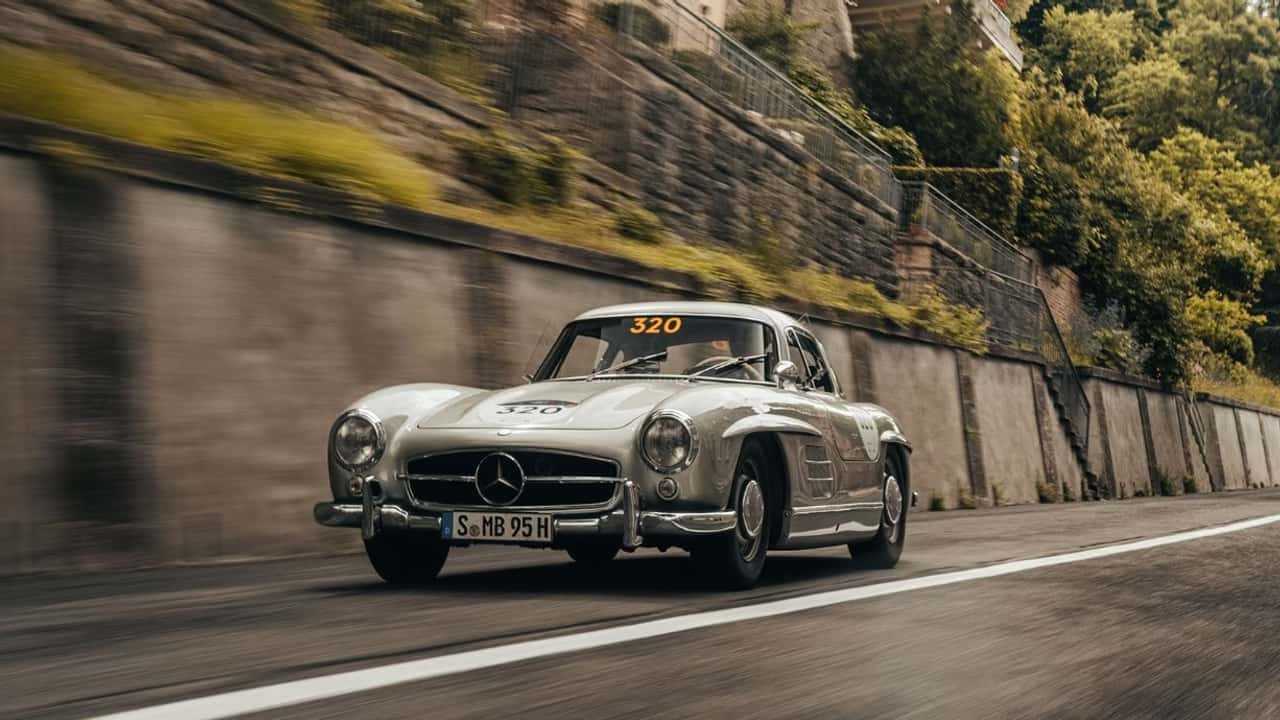
The Mercedes-Benz 300 SL is one of the most recognizable sports cars ever built, and its gullwing doors are a big reason why. When the legendary coupe debuted in 1954, its roof-hinged doors looked like something from the future, setting it apart from virtually every other car on the road. More than 70 years later, they remain one of the most iconic design features in automotive history.
But those spectacular doors weren’t originally created to make the car look dramatic. Their unusual design was born out of an engineering challenge inherited from the 300 SL’s racing predecessor.
Mercedes-Benz wanted a lightweight, rigid chassis capable of delivering serious performance, but its construction made conventional doors difficult to accommodate. The solution was as clever as it was unconventional, turning a practical necessity into an enduring automotive legend.
It Started With A Racing Car
To understand why the Mercedes-Benz 300 SL had gullwing doors, we need to go back to 1952. That year, Mercedes-Benz returned to international sports car racing with the W 194, a competition car developed to challenge some of the world’s best endurance racers.
At the heart of the machine was a lightweight tubular space frame. Rather than using a conventional chassis, engineers built a structure from interconnected steel tubes arranged to provide considerable rigidity without adding excessive weight. The design helped the car achieve impressive results, including victories at Le Mans and the Carrera Panamericana.
However, this ingenious construction came with a drawback. The frame’s structural tubes extended unusually high along the sides of the cockpit, creating deep side sills that occupied the space where conventional doors would normally be fitted.
Cutting large openings into those structural sections could compromise the chassis’s rigidity. Mercedes-Benz therefore needed another way to let drivers and passengers enter the cabin without sacrificing the advantages of its racing-inspired construction.
Why Conventional Doors Weren’t An Option
On a conventional car, doors hinge at the front and swing outward, allowing occupants to climb over relatively low sills. The 300 SL’s tall tubular frame made that arrangement impractical.
With so much of the structure rising alongside the cockpit, a traditional door opening would have been difficult to engineer without major changes to the chassis. Mercedes-Benz needed to preserve the frame’s strength while providing sufficient access to the cabin.
The solution was to hinge the doors at the roof. Instead of opening outward, they swung upward, creating large openings that extended into the roof area. Occupants could step over the high sills and lower themselves into the seats.
The design also came with compromises. Climbing in and out wasn’t especially graceful, particularly for taller occupants, and the doors required adequate overhead clearance. The coupe’s side windows were removable rather than conventional wind-down units, reflecting the unusual packaging of the cabin.
Nevertheless, the arrangement solved the fundamental problem without abandoning the car’s distinctive chassis design. What began as a practical engineering response became the feature that would define the 300 SL for generations.
The Engineering Behind The Gullwing Doors
The gullwing doors weren’t the only unusual feature of the 300 SL. The entire car reflected Mercedes-Benz’s effort to transfer racing technology into a road-going sports car. Several elements helped make the coupe stand out in the 1950s:
Tubular space frame: The lightweight steel structure provided rigidity while keeping weight under control, but its high sides restricted conventional door placement.
Roof-mounted hinges: The upward-opening doors provided access to the cabin without requiring traditional side-hinged openings through the tall frame.
3.0-liter inline-six engine: The production 300 SL delivered approximately 215 horsepower, giving it formidable performance for its era.
Mechanical direct fuel injection: The engine used an advanced fuel-delivery system that helped distinguish the road car from many contemporary production sports cars.
Aerodynamic bodywork: Its streamlined shape reduced drag and contributed to the car’s remarkable top speed, which could approach 160 mph (260 km/h) depending on specification.
Together, these features made the 300 SL much more than a sports car with unusual doors. It was a showcase for advanced engineering, with its appearance closely connected to the demands of performance.
Why The 300 SL Roadster Had Conventional Doors
If the gullwing doors were so closely associated with the 300 SL, why did Mercedes-Benz abandon them when it introduced the Roadster in 1957? The answer lies, again, in the chassis. For the open-top model, Mercedes-Benz revised the frame’s side sections to allow lower door openings. That made conventional doors practical while providing easier access to the cabin.
The Roadster also offered a different ownership experience. Without a fixed roof, it delivered open-air motoring, while changes to the structure helped accommodate its revised body style. The model retained the 300 SL’s essential performance character but didn’t need to preserve every feature of the original coupe.
This is an important part of the gullwing story. The doors weren’t an indispensable component of the car’s mechanical performance. They were a solution to a specific packaging challenge created by the original space frame.
Once engineers changed the structure, they could use a more conventional design. The Roadster demonstrated that Mercedes-Benz was willing to prioritize usability when the engineering circumstances allowed it.
What Do Car Enthusiasts Think About The Mercedes 300 SL?
The Mercedes-Benz 300 SL continues to attract admiration on Reddit, where enthusiasts celebrate its timeless styling and racing heritage. In a discussion on r/mercedes_benz, commenters praised the car’s unmistakable appearance, with one calling it a “300SL, damn what a beaut.” The reaction shows just how strongly the classic Mercedes still resonates with car fans today.
Other discussions highlight the appeal of the later Roadster, which replaced the Gullwing Coupé in 1957. In a thread on r/oldcars, some enthusiasts argued that the open-top model would be more enjoyable to drive, while others preferred its predecessor’s dramatic doors. The debate illustrates how the 300 SL’s legacy extends beyond one distinctive design feature.
The conversation also reflects the car’s rarity and enduring collector appeal. In an r/classiccars discussion, users discussed production numbers and how many examples might still survive. Taken together, these threads show that enthusiasts value the 300 SL for its combination of engineering, beauty, and exclusivity—not just its famous gullwing doors.
A Practical Solution That Became An Icon
Mercedes-Benz built approximately 1,400 300 SL Gullwing Coupés between 1954 and 1957. Today, the model is one of the most celebrated classic sports cars, prized for its racing pedigree, technological sophistication, and unmistakable silhouette.
The doors certainly helped make the car famous, but their significance goes beyond appearance. They tell the story of how a design limitation can lead to an unexpected solution, particularly when engineers refuse to compromise on the fundamentals of a vehicle’s construction.
That solution eventually became one of the most recognizable automotive designs ever produced. It also explains why the gullwing doors remain so fascinating: they weren’t simply styled to look spectacular. They were the visible result of a serious engineering challenge.
Sometimes, the most memorable automotive design is not created on a drawing board to attract attention. It’s what happens when engineers solve a difficult problem and, in the process, create something extraordinary.
Every Rolls-Royce Has A Hidden Feature Most People Don’t Know About
The Strange Reason The Golf GTI Had A Golf Ball Shifter
Who Were The Pep Boys, Anyway?
Remember When Saab Put The Ignition Key Between The Front Seats?