If you’ve ever seen an old Lincoln Continental or Cadillac Eldorado Brougham, a Rolls-Royce, or a Mazda RX-8, you’ve probably noticed that the rear doors open in the “wrong” direction. Instead of hinging at the front, the rear doors are hinged at the back. They’re commonly called “suicide” doors, although automakers have used much friendlier names such as coach doors and freestyle doors.
It sounds like a strange idea today, but rear-hinged doors were once fairly common. They weren’t invented as a dangerous gimmick, either. The layout offered some genuine advantages for getting into and out of a car, and it was inherited from the horse-drawn carriages that preceded automobiles.
So why did automakers eventually move away from them?
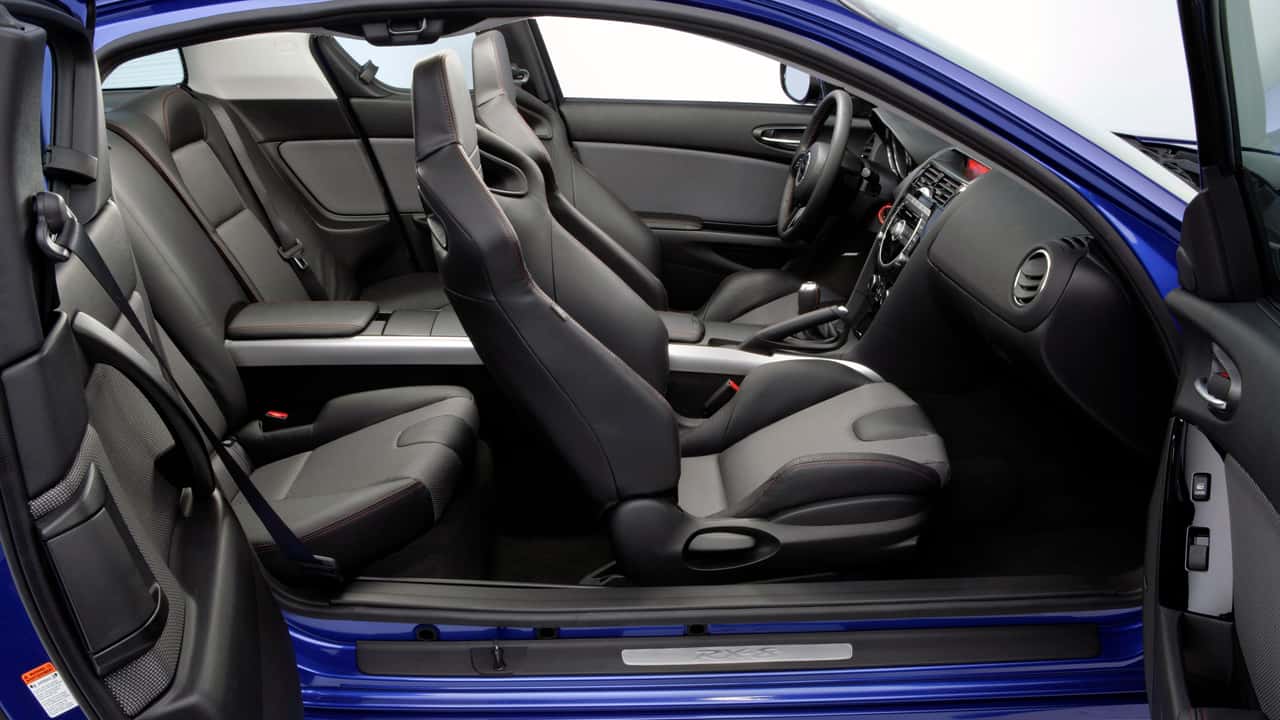
Mazda RX-8 Suicide Doors
Photo by: Mazda
They Were Actually A Practical Idea
Rear-hinged doors weren’t originally some bizarre automotive experiment. The concept came from horse-drawn carriages, where rear-hinged doors were already being used to make it easier for passengers to climb aboard and step back out. As automobiles evolved, manufacturers carried the idea over to early cars.
There was a simple advantage: access. A rear-hinged door can create a wide, relatively unobstructed opening. For passengers climbing into the back seat, especially in large luxury cars, that could make getting in and out considerably easier.
The design also had an undeniable visual appeal. On chauffeur-driven luxury cars, opening the rear door toward the rear of the vehicle created a dramatic entrance and made it easier for a passenger to step directly toward the curb.
That’s one reason the configuration became associated with formal and luxury automobiles. The famous 1961–1969 Lincoln Continental is perhaps the best-known American example, while Rolls-Royce has continued the basic concept into the modern era with models like the Phantom and Ghost sedans, Wraith coupe, and Cullinan SUV.
Then The Doors Got A Very Bad Reputation
Here’s where the ominous nickname comes in. Older cars didn’t have the sophisticated door latches, safety systems, and widespread seat-belt use that modern vehicles have. If a rear-hinged door wasn’t securely latched, airflow around a moving car could potentially force it farther open rather than helping push it shut.
That created an obvious problem for an unrestrained passenger sitting next to the door. The concern became particularly important because early automobiles often lacked seat belts. A passenger who fell out of a moving vehicle had little protection from the road or surrounding traffic.
That’s where their ominous name comes from. Modern sources generally describe the “suicide” name as a reference to the perceived danger of the configuration rather than an official engineering term.
There was another problem when the car was parked. If someone opened a rear-hinged door into traffic and another vehicle struck it, the geometry could create a particularly nasty situation for someone standing beside the door.
So the design wasn’t necessarily doomed because rear hinges themselves were inherently unsafe. Rather, older vehicles lacked many of the safety systems that make the configuration much more manageable today.
Why Did Lincoln And Other Cars Keep Using Them?
The most famous example is the 1961 Lincoln Continental, and its rear doors weren’t there just because designers thought they looked cool.
Lincoln wanted a four-door convertible, but the body structure presented a problem. Without a conventional B-pillar, the usual arrangement for supporting the front and rear doors wasn’t available. Rear-hinging the back doors helped make the unusual body configuration work while also providing excellent access to the rear seats. The result became one of the most recognizable American cars of the 1960s.
Other manufacturers used the design for different reasons. In some applications, rear-hinged doors provided easier access. In others, they helped create a particular body shape or allowed manufacturers to eliminate or minimize a conventional center pillar.
That’s why you’ll find the design on everything from old luxury cars to taxis and compact vehicles. It wasn’t one solution to one problem—it was a flexible piece of automotive packaging.

2027 Genesis GV90 Coach Doors
Photo by: Genesis
Some Modern Cars Brought The Idea Back
Rear-hinged doors didn’t completely disappear. They just became much less common. Modern cars have shown that the concept can still be useful when combined with modern latches, seat belts, electronic safety systems, and carefully engineered structures.
The Mazda RX-8 is one of the best examples. Mazda called its setup Freestyle Doors, with conventional front doors and smaller rear-hinged doors. The RX-8 used the arrangement to provide easier rear-seat access without turning the car into a conventional large four-door sedan.
Other modern examples have included vehicles such as the BMW i3, Honda Element, Toyota FJ Cruiser, and most recently, the new Genesis GV90. Luxury manufacturers, meanwhile, have continued using full-size rear-hinged doors as part of the chauffeur-focused experience. And there are some interesting names for them:
Rolls-Royce: Coach doors
Genesis: Coach doors
Mazda: Freestyle doors
Opel: FlexDoors
Saturn: Rear-access doors
The terminology changes, but the basic idea is the same: the hinges are at the back instead of the front.
Car Buffs Can’t Agree On Why Suicide Doors Disappeared
Reddit has had plenty of debates over why rear-hinged doors aren’t common anymore. In a popular r/cars discussion, owners pointed to several possible reasons, including the safety implications of a rear-hinged door opening unexpectedly and the added complications of getting in and out in tight parking spaces.
Safety is the biggest recurring theme. One commenter explained that with a conventional front-hinged door, airflow can help keep a partially unlatched door closed at speed, whereas a rear-hinged design could potentially be pushed open. Others brought up the danger of a rear-hinged door being struck while someone is entering or exiting the vehicle.
But the thread also shows why people still like them. Owners of vehicles such as the Honda Element and various pickup trucks said the doors can create a wide opening and make it easier to access the cabin. Some even preferred the arrangement, particularly when the front and rear doors could open together to create one large opening.
There’s also a surprisingly strong argument over what actually qualifies as a suicide door. Redditors pointed out that the rear-hinged doors on cars such as the RX-8 and Honda Element aren’t necessarily the same as traditional full-size suicide doors because some require the front door to be opened first. A separate r/cars discussion also debated whether any rear-hinged door should count or whether the term should be reserved for independently opening doors.
So Why Don’t More Cars Have Them Today?
The short answer is that modern cars have to balance door design with crash structure, packaging, cost, and ease of use.
A conventional four-door layout gives engineers a straightforward way to incorporate a strong center structure between the front and rear doors. Removing or changing that structure can make crash engineering more complicated.
Mazda’s own technical documentation on the RX-8, for example, describes the engineering work required to make its pillarless Freestyle Door System meet side-crush requirements. Mazda used a high-strength steel “built-in pillar” within the rear-door structure and latches at both the top and bottom to transfer crash loads into the body.
Modern rear-hinged doors can therefore be perfectly practical, but they’re no longer the simple solution they once were. And that’s really the story of suicide doors. They weren’t created because automakers wanted to make cars dangerous. They offered easier access, distinctive styling, and useful packaging at a time when automotive design was still evolving. As safety expectations and vehicle structures changed, conventional front-hinged doors became the norm.
Today, the rear-hinged door survives mostly where its advantages—or its dramatic appearance—are worth the extra engineering. Genesis’ new GV90 flagship SUV is a good, albeit increasingly less common, example.
Why Every Driver Should Keep A Portable Jump Starter In The Car
Why Do EVs Make That Weird Noise At Low Speeds? It’s Actually A Safety Feature
Why Do Modern Cars Have Those Giant Plastic Engine Covers?
Those Grooves In Your Tires Do A Lot More Than You Think