- U.S.-based battery startup Pure Lithium is working on a graphite-free LFP battery.
- The startup is in discussions with 40 companies to commercialize its technology.
- It promises to double the energy density, halve the weight and vastly reduce costs.
Chicago-based battery startup Pure Lithium is working on a potentially disruptive battery that it claims is cheaper and more energy dense that what’s out there while relying on a North American supply chain. It’s not solid-state, and it’s not a silicon-anode battery. It’s actually a lithium iron phosphate (LFP) battery without the graphite traditionally used in lithium-ion packs.
The startup claims to have achieved a breakthrough this past week, with its lithium-metal battery reaching 9,315 charge-discharge cycles. That is more than three times the cycle life of a conventional lithium-ion battery, and Pure Lithium said it’s unprecedented: “To the Company’s knowledge, no other lithium metal battery in development has achieved such results under equivalent testing conditions.”
The vast majority of today’s lithium-ion batteries depend heavily on Chinese supply chains. Now, there’s a push in North America not only to break that dependence, but also to advance lithium-ion technology so electric vehicles can drive farther, charge faster and last longer. Pure Lithium says it has eliminated the graphite anode, which is expensive and dirty to mine.
“It’s half the weight and double the energy density of the battery that we’re all using today,” CEO Emilie Bodoin said in a Bloomberg interview. A major reason for that, she argues, is getting rid of graphite. The battery isn’t on the market just yet, though; Pure Lithium is building a pilot line in Chicago and looking for partners to help it commercialize its tech, Bodoin said.
CATL Shenxing Pro LFP battery
Photo by: CATL
More than 90% of the world’s graphite is processed in China. Graphite also adds weight and takes up valuable space inside a battery cell. It does not actively participate in the battery’s electrochemical reaction. Instead, it primarily acts as a host material that allows lithium ions to be stored and released during charging and discharging, according to the startup. Pure Lithium’s argument is to get rid of the graphite, free up space inside the cell, and use that space for more usable energy material.
For the cathode, Pure Lithium is using LFP chemistry, which itself has historically been heavily dependent on Chinese supply chains but is now slowly becoming more localized in the U.S. That means its lithium metal LFP battery eliminates the need for several expensive and dirty materials, including nickel, manganese, cobalt, and graphite. While nickel-rich chemistries certainly offer higher energy density than LFP, Pure Lithium says it can make up for that difference by freeing up space on the anode side of the cell and eliminating graphite.
The 9,000-plus cycles it achieved in the laboratory were performed at 1C charge and discharge rates. In simple terms, that means the battery was fully charged for one hour and then fully discharged for one hour, repeatedly, for more than 9,000 cycles. That’s actually very tough on the cell and tests its limits. In real world use, batteries are rarely stress tested to such extremes.
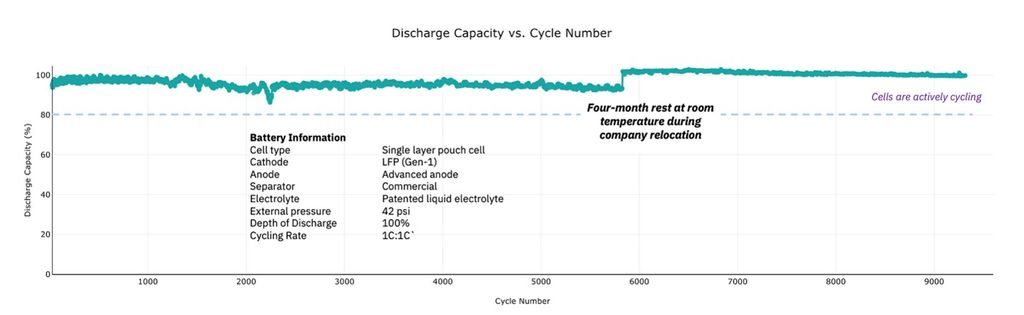
Pure Lithium’s battery barely lost capacity over thousands of cycles, but a four-month rest during the experiment appears to have helped.
Photo by: Pure Lithium
A commercial lithium-ion battery typically degrades noticeably over its lifespan. But this lab-tested cell barely budged. The company shared a graph showing the battery retained nearly all its discharge capacity after 9,000 cycles. Testing wasn’t continuous, though. The company paused around the 6,000-cycle mark while relocating its headquarters from Boston to Chicago, letting the battery rest at room temperature for four months. When testing resumed, the battery showed even more capacity retention compared to when it paused.
The company also noted that “larger fluctuations in the early part of the cycles were due to the lack of temperature control and multiple power failures in Pure Lithium’s 1.0 Boston laboratory.”
During a previous test in January 2025, Pure Lithium said its battery had retained more than 80% of its capacity after 2,200 cycles at a similar 1C charge and discharge rate. So the newer cell appears to be even more robust. It’s also not clear what the energy density was of the specific cell used for the 9,315-cycle test. Pure Lithium says its Gen 1 battery has an energy density of 300 watt-hours per kilogram, while its Gen 2 battery is expected to reach 425 Wh/kg.
“All of the manufacturers are very familiar with [lithium metal technology],” Bodoin said, referring to the 40-plus companies the startup is currently in discussions with to scale its technology. “What we have done is make it low cost, and we have a very good way to make our lithium anode, a whole battery component in just one step using this magic called electrodeposition.”
The battery may be graphite-free, but it’s not anode-free. Instead, the startup uses a process called electrodeposition to create its lithium metal anode. Essentially, lithium metal is deposited directly onto a copper current collector until it reaches the desired thickness, creating the anode as part of the manufacturing process, S&P Global previously reported.

Battery makers around the world are now dipping their toes into all sorts of chemistries, both to make supply chains more regional and to improve the underlying technology. Several companies are working on silicon or synthetic graphite anodes, while multiple U.S. startups are trying to reduce North America’s reliance on China with their own versions of lithium metal batteries.
American startups Factorial, Solid Power, and QuantumScape are all working on graphite-free lithium metal batteries, too. But their approaches differ from Pure Lithium’s. Factorial and QuantumScape are pursuing solid-state or semi-solid-state electrolytes, while Solid Power is developing both silicon-anode and lithium-metal technologies around its sulfide solid electrolyte. Pure Lithium, meanwhile, uses a liquid electrolyte and is putting much of its emphasis on how the lithium-metal anode is produced.
In other words, there are now several different bets being made on what comes after today’s conventional lithium-ion battery. Only time will tell which of these approaches ultimately makes it out of the lab, reaches mass production, and, potentially, changes the game.
Contact the author: [email protected]