- Tesla’s U.S. sales fell by over 8% in the first quarter, according to Cox Automotive estimates.
- Still, it gained market share as the broader EV market contracted sharply.
- The Model Y continued to be a hot seller, but the Cybertruck and Model 3 struggled.
In the first quarter of 2026, Tesla sales plummeted in the U.S., marking its third straight year of Q1 sales declines. The last time Tesla’s Q1 and full-year sales in America grew was in 2023. Barring a few exceptions, it has been mostly downhill ever since.
The Texas-based automaker sold 117,300 units in the U.S. in the first three months of this year, representing its lowest quarterly sales since late 2021 and an 8.4% year-over-year decline, according to Cox Automotive estimates. The first quarter of last year was a low bar to begin with, with Tesla posting its worst results in two years during that period.
But the rest of America’s EV industry fell harder, buoying Tesla’s share of the market. In total, automakers sold 216,399 EVs in the U.S. between January and March, Cox says, 27% fewer than the same period last year. Non-Tesla EV sales fell by a whopping 41%, according to an InsideEVs analysis of Cox’s data. Tesla not only held firm as the U.S. EV sales leader, but its market share jumped from 43.2% to 54.2% year over year.
Photo by: InsideEVs
The expiration of federal tax credits last September and the end of regulations driving clean-car sales have hit the reset button on the U.S. EV industry. Automakers have since scaled back their EV ambitions, reallocating those resources towards combustion engine models and hybrids. Companies are also canceling models left and right.
Tesla isn’t immune to the broader headwinds. But company-specific troubles have compounded the effect. Elon Musk has pivoted hard toward AI and robotics, with Tesla’s core passenger-vehicle business taking a back seat. Tesla has not released a new model since the Cybertruck came out in late 2023.

2026 Tesla Model 3 Standard
Photo by: Tesla
Still, the shakeout has allowed Tesla to capture a larger share of the smaller total market. For years, the EV pioneer’s dominant position gradually eroded as rivals piled in and the pie grew. Now the trend has reversed.
While a rush to claim the EV tax credit before it expired on September 30 created a boom-and-bust cycle for the entire car industry, Tesla’s sales weren’t nearly as volatile. From Q3 to Q4 of 2025, non-Tesla EV sales in the U.S. cratered by some 63%. Tesla sales dropped too, but only by 23%, boosting its slice of the EV market to over half for the first time since early 2024.
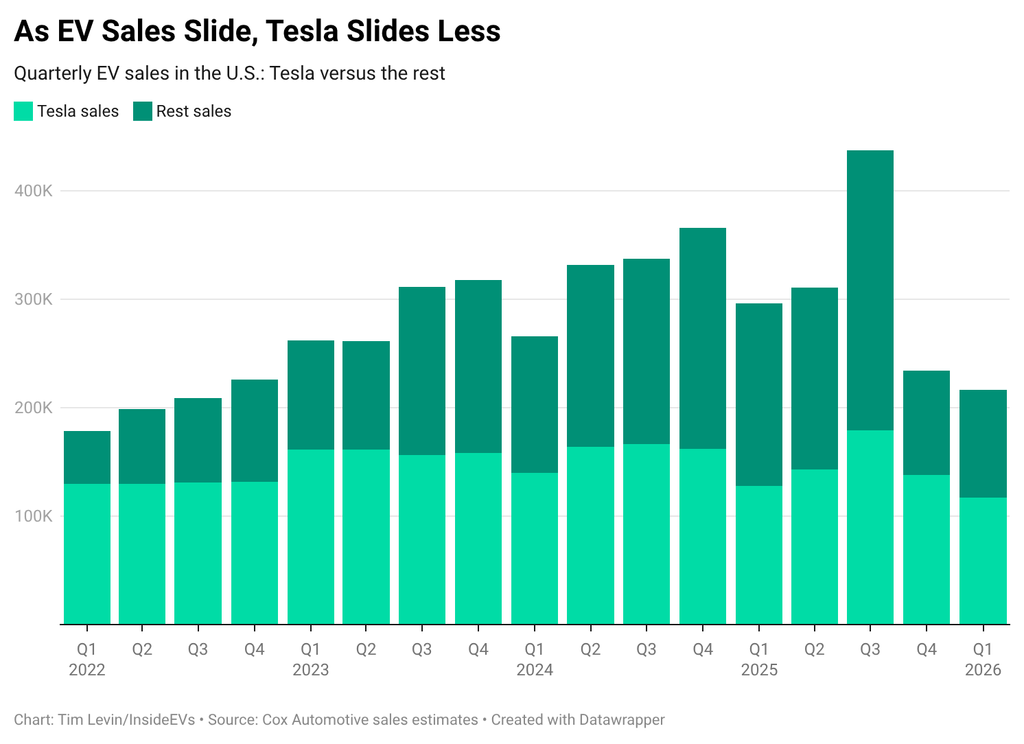
Photo by: InsideEVs
Tesla’s sales are mainly driven by one vehicle: the Model Y. One in three EVs sold in the U.S. in Q1 was a Model Y, and the crossover made up 67% of Tesla’s own sales. It remains one of the strongest overall EVs in terms of range and software, and its competitive pricing has kept demand hot even as the broader market contracts. Model Y sales grew 22% year over year, Cox says. (Remember that in the early part of last year, Tesla was changing over production lines to the new Model Y design, depressing production.)
The automaker’s other models, on the other hand, are suffering. The Model 3 posted one of its worst quarters in years, with 31,672 estimated sales, a nearly 40% year-over-year decline. The last time the Model 3 had such disappointing Q1 sales was in 2024, when it was undergoing the “Highland” mid-cycle refresh. It’s also a sedan in a sea of electric SUVs and crossovers that American buyers overwhelmingly prefer.
Photo by: Tesla
The Cybertruck’s Q1 drop was even worse, albeit from a much lower baseline. The truck saw a 45% year-over-year decline and just 3,513 sales. Tesla once planned to sell more than 250,000 units annually, but the wedge-shaped stainless steel truck has turned out to be an epic flop—with a small group of dedicated fans. Sales Model S and Model X, which have now been discontinued, also fell sharply in Q1, but they have not contributed meaningfully to Tesla’s sales for quite some time.
If things continue on this trajectory, Tesla could be in for a third straight year of declining sales. There are some hints of new models in the pipeline, but nothing is official yet. Reuters reported this week that the automaker has un-cancelled plans to make a compact SUV that is cheaper and smaller than the Model Y. And no, this time around, it won’t just be a stripped-down version of its siblings. Plus, Musk also recently said in an X post that “something way cooler than a minivan” was coming.
At the moment, the Model Y continues to do all the heavy-lifting for the brand. And in the current EV climate, that’s enough to maintain market share, or even grow it. But as electric car sales grow over the long run, Tesla could find itself outflanked.
Contact the author: [email protected]
Additional reporting by Tim Levin